

Contact
ADDRESS
STAVROS NIARCHOS FOUNDATION
CULTURAL CENTER
364 Syggrou Avenue, Kallithea
TEL.
Box Office:
+30 213 0885700
Box Office email:
boxoffice@nationalopera.gr
Daily 09.00-21.00
info@nationalopera.gr
Register to our Newsletter






CONDUCTOR
Andreas Tselikas (29, 30/4 - 2, 3/5)
Yorgos Aravidis (5, 6, 7/5)
DIRECTOR
Vassilis Papavassiliou
SETS - COSTUMES
Giorgos Ziakas
MOVEMENT
Fotis Diamantopoulos
LIGHTING
Eleftheria Deko
CHORUS MASTER
Agathangelos Georgakatos
VARONÀS
Pavlos Maropoulos (29/4 - 2, 3, 7/5)
Kostis Rasidakis (30/4 - 5, 6/5)
MR LATROUDIS
Angelo Simo (29/4 - 2, 5, 7/5)
Stamatis Beris (30/4 - 3, 6/5)
MRS LATROUDI
Αlexandra Mattheoudaki (29/4 - 2, 5, 7/5)
Lydia Angelopoulou (30/4 - 3, 6/5)
ΑNNA
Elena Kelessidi (29/4 - 2, 5, 7/5)
Despina Scarlatou (30/4 - 3, 6/5)
ADRIANÒS
Dimitris Paksoglou (29/4 - 2, 3/5)
Nikos Stefanou (30/4 - 5, 6, 7/5)
RITA
Georgia Eliopoulos (29/4 - 2, 5, 7/5)
Μaria Kokka (30/4 - 3, 6/5)
DIMOSTHENIS
Thanassis Dimou (29, 30/4 - 2, 3, 5, 6, 7/5)
POLICE SERGEANT
Kostas Dotsikas (29/4, 5, 6, 7/5)
Costas Mavrogenis (30/4 - 2, 3/5)
MIMIS
Nikos Tsaousis (29/4 - 2, 5, 7/5)
Anastasios Stellas (30/4 - 3, 6/5)
PETROS
Manolis Lorentzos (29/4 - 2, 5, 7/5)
Stavros Giannoulis (30/4 - 3, 6/5)
With the GNO Οperetta Orchestra and Chorus
29, 30 April 2015
2, 3, 5, 6, 7 May 2015
Municipal Theatre of Piraeus
Performances begin at 20.00 | 
BALLET
Ballet Director
tba
Artistic Coordinator
tba
Ballet Curator
Xenia Vlahopoulou
Artistic Collaborator
Dimitra Palatsidi
Ballet Εducational Projects
Athina Vrouva
Assistant Choreographers /
Rehearsal Supervisors
Dimitra Laoudi
Fotis Diamantopoulos
Physiotherapists
Thanassis Kainourgios
Edward Katsikian
Isadella Mitrou
Konstantina Zerva

7 May 2015
SNFCC Visitors Center
Starts at 19.00 |
Free admission

DIRECTION
Angela-Kleopatra Saroglou
SETS
Yorgos Kollios
COSTUMES
Alexia Theodoraki
LIGHTS
Spyros Tzoras
PIANO
Yiannis Tsanakaliotis
DON JOSÉ
Dimitris Paksoglou
ESCAMILLO/MORALLÈS
Yannis Selitsaniotis
ZUNIGA/LE DANCAÏRE
Costas Mavrogenis
CARMEN
Ines Zikou
MICAËLA/FRASQUITA
Sofia Mitropoulou
MERCÉDÈS
Eleni Davou
7 May 2015
CULTURAL CENTRE, CHANIA
Performances begin at 20.00 |
Free entrance for priority pass holders. Priority passes will be distributed one hour prior the starting time
[Carmen at a glance]
The composer / French composer Georges Bizet was born in Paris, in 1838 and died in Bougival, near Paris, in 1875. His first music teacher was his father, a vocal coach. Later, he studied at the Conservatoire de Paris, under Jacques Fromental Halévy, composer of the opera La Juive and whose daughter Bizet married in 1869. Apart from his studies at the Conservatoire, Georges Bizet also studied under Charles Gounod and was profoundly influenced by him. When in 1857 Bizet won the prestigious Grand Prix de Rome, he had already composed the noteworthy Symphony in C, which was performed for the very first time as late as 1935! The arrangement of his poor financial state was the first thing he did upon his return to Paris from the Villa Medici. His opera Les pêcheurs de perles (1863) was not as successful as anticipated. Following the Franco-Prussian War (1870), he was appointed chorus master at the Opéra de Paris, but he opted for the position of the rehearsal pianist & répétiteur at the Opéra Comique. In 1872 he scored his first great success thanks to the music he composed for the theatrical play L'Arlésienne, based on the eponymous novel by Alphonse Daudet. In March 1875 he experienced the tumultuous premiere of his Carmen, but did not enjoy the work’s huge recognition for he died only a few months later, at the age of 37.
The opera / Carmen is a four-act French opera and belongs to the genre opéra comique. It is based on a libretto written by Henry Meilhac and Ludovic Halévy, based on Prosper Mérimée's namesake novel (1845). The term opéra comique does not suggest the existence of comic elements, but relates to structural and aesthetical features, one of which being spoken dialogues. In 1875, on the occasion of presenting Carmen in Vienna, Ernest Guiraud replaced the dialogues with recitatives. Also, he added some dance scenes by borrowing music from the suite L'Arlésienne and from Bizet's opera La jolie fille de Perth.
Premieres / Carmen first premiered in Paris at the Salle Favart. It was staged by the Opéra Comique on 3 March 1875. The leading role was performed by Célestine Galli-Marié. The performance staged in Vienna (October 1875) was pivotal as to the acknowledgment of the opera. Carmen was included in the repertoire of the Greek National Opera in 1941-2, with Kitsa Damasioti as Carmen and Antonis Delendas and Nikos Glinos at the role of José, Fani Aidali as Micaëla and Spyros Kalogeras as Escamillo. Antiochos Evangelatos was the conductor.
Act I / At a café in a square of Seville, soldiers comment leisurely on the passers-by while waiting for Carmen who works nearby to show up. Eventually, Carmen comes and almost threatens her admirers by singing a song about the fickle nature of love. Reacting to Zuniga's persistent flirt, she takes refuge to Don José by kissing him in a provocative manner and throwing him a flower. Although Don José seems to be annoyed, he keeps the flower. Carmen and Mercédès return to work. Micaëla enters the stage and gives José a kiss and a letter from his mother. In the letter his mother designates Micaëla as a suitable wife for him. Voices are heard, Carmen and Zuniga enter the stage again, but this time in dispute. Carmen keeps a suspicious object in her bag, but she won't give any explanations. Zuniga asks Don José to lead her to prison. Once they are left alone, Carmen charms the officer and in exchange of liberating her she pledges her love to him. Don José helps her escape.
Act II / In a bar. Carmen and Mercédès work night shift. Escamillo, the famous toreador, arrives. Carmen seems to be disinterested, but she lets him hope. Don José arrives and Carmen joyously dances for his sake. When he explains to her that duty calls him and has to leave, Carmen is outraged; she remains unmoved both at the view of the flower of their first encounter and by his marriage proposal. As she explains, if he loves her, he must leave her and make a fresh start someplace else. The lieutenant of the guards (Zuniga) returns hoping to find Carmen alone. Don José, jealous of Zuniga, attacks him. Now he has no other choice but to follow Carmen.
Act III / In a deserted place where Carmen and Don José have taken refuge. Micaëla comes dispirited only to inform Don José that his mother is dying. When she perceives that someone is following her, she hides. The person following her is Escamillo who has come to claim Carmen. Don José is furious and challenges him in a duel. At this point Carmen interrupts them and Escamillo invites everyone to his next bullfighting. Micaëla turns up informing Don José that his mother is on her death bed. He threatens Carmen and follows the girl. Carmen is mesmerised by Escamillo and follows his voice.
Act IV / In Escamillo's dressing room. Carmen helps him in his preparations for the arena. Escamillo bids her a warm goodbye and enters the arena. Carmen is left alone and watches the bullfighting on a monitor. Don José rushes in and insists on her following him. She openly tells him that she does not love him and that she would rather die than losing her freedom. Through the arena she can hear the cheering crowd and she is about to dash and take a taste of Escamillo's triumph, but Don José stands in her way. She gives him back the ring he had given her as a token of his love and kills her the very moment the bull strikes a deadly blow at Escamillo.
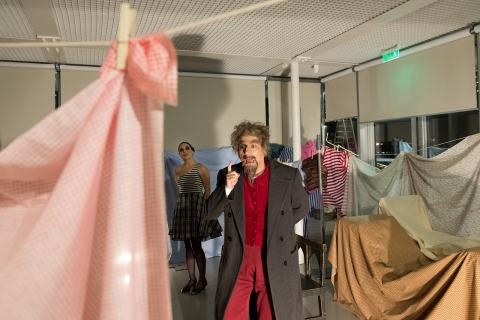
Director's note / Although today Carmen is synonymous with Spain, nobody remembers that its composer had never visited the Iberian Peninsula before composing this work that was to reserve him a place amongst the most celebrated opera composers. In the abridged version of the work we prepared for the Suitcase Opera, our aim was to narrate the story from a different angle with regard to Spain and its particular character. We kept intact the opera's dramatic core in which the dynamic rapport that develops among the main characters is skilfully outlined through music and dramatic performance. However, the grand spectacle and the vivid, crowded scenes were left out. In essence, every abridged version is a new creation. Consequently, our intent was to place our own Carmen in the Spain of the 1990s, in Seville; a city whose history is always evident and where the past encounters the present, and both engage in a discourse with daily life.
Almodovar's films are our focal point of reference as far the aesthetics are concerned. Through his cinematography we saw Spain from a different viewpoint and we became familiarised with the country, perhaps more than Bizet was in his time. Our version presents two different worlds that meet and eventually come into conflict: on the one hand we see the conservative, Catholic and provincial Spain (especially Southern Spain); on the other hand there is the emancipated Spain and its big cities of the post-Franco era, the way it is depicted in Almodovar's films. The gypsy element was consciously omitted from our narration because in the past it bore different connotations from today and especially because in the original text it is used as an explanation for the deviant nature of Carmen and her comrades. Our decision to dispense with this outdated pseudo-exotic element did not emerge from the need to be politically correct, but rather from our choice to be more loyal to the spirit of the work and our decision to depict Carmen as a contemporary woman who is trying to survive by working day and night. She is a woman who knows the nitty-gritty of the world both under the bright light of day and in the darkness of night, making her a lot more experienced than Don José who grew up in a safe bourgeois environment. Carmen does not aspire to have a family and children; she knows that her desires would cost her dearly. However, she had never imagined the price would be so high…
TRANSLATION
Dimitris Dimopoulos
DIRECTOR
Ion Kessoulis
SETS
George Kolios
COSTUMES
Avgi Delega
CHOREOGRAPHY
Dimitra Vlachou
CONDUCTOR, PIANO
Chrysanthos Alissafis
VESPETTA
Myrsini Margariti
PIMPINONE
Vangelis Maniatis
6 May 2015
5th HIGH SCHOOL OF KALLITHEA
Performances begin at 12.00 |
Admission is free
3 May 2015
Olympia Theatre's Foyer
Performances begin at 18.00 |
General admission: 5€
TRANSLATION
Dimitris Dimopoulos
DIRECTOR
Ion Kessoulis
SETS
George Kolios
COSTUMES
Avgi Delega
CHOREOGRAPHY
Dimitra Vlachou
CONDUCTOR, PIANO
Domna Chalari
VESPETTA
Vassia Zacharopoulou
PIMPINONE
Zafiris Koutelieris
3 May 2015
PALAIO FALIRO TOWN HALL
Performances begin at 19.00 |
Admission is free

3 May 2015
SNFCC Visitors Center
Starts at 19.00 |
Admission is free

CONDUCTOR
Elias Voudouris
CHOREOGRAPHY - LIGHTING
Renato Zanella
STAGE DESING - COSTUMES
Christian Lacroix
Stage design based on drafts of Anton Brioschi, kindly provided by Österreichisches Theatermuseum, Vienna
Sets, props and costumes produced by ART for ART Theaterservice GmbH, Vienna
JOHANN STRAUSS ΙΙ
Aleksandar Neskov (24, 26, 29/4)
George Varvariotis (25, 28, 30/4)
MADAME LEONTINE, GRETE'S STEPMOTHER
Stratos Papanoussis (24, 25, 26, 28, 29, 30/4)
GRETE (CINDERELLA)
Νadia Muzyca (24, 26, 29/4)
Μaria Kousouni (25, 28, 30/4)
Gustav, prince Danilo Zeka (24, 26, 29/4)
Vangelis Bikos (25, 28, 30/4)
FANCHON - ΥVETTE, THE TWO SISTERS OF GRETE
Vanessa Kourkoulou - Popi Sakellaropoulou (24, 25, 28, 30/4),
Eleana Andreoudi - Anna Fragou (26, 29/4)
ΜISS CERRINI, PRIMA BALLERINA
Νatasha Siouta (24, 25, 26, 29/4)
Eleana Andreoudi (28, 30/4)
MR. QUERRA, ERSTER
Igor Siadzko (24, 25, 28, 30/4)
Αgapios Agapiadis (26, 29/4)
Waltz By the Beautiful Blue Danube / Klipp-Klapp Galop
24, 25, 26, 28, 29, 30 April 2015
Megaron, The Athens Concert Hall - Alexandra Trianti Hall
First staging by the Greek National Opera - A production of Wiener Staatsballett, 1999
Performances begin at 20.00 |
Studienleiter
Sofia Tamvakopoulou
Répétiteurs-Coaches (Soloists)
Chryssanthos Alissafis
Irini Antoniadou
Domna Halari
Frixos Mortzos
Maria Neophytidou
Christis Sakellaridis
Marilena Souri
Sofia Tamvakopoulou
Nikos Vasileiou
Répétiteurs (Ballet)-Pianists
Eris Moustidi-Meloyannidi
Anastasios Chamilakis
Répétiteurs (GNO Ballet School)-Pianists
Zelitska Karanovitz
Giorgos Kontovas
Alexandros Pourloukakis
Betty Santamouri
Loukas Tsolakian

30 April 2015
SNFCC Visitors Center
Starts at 19.00 |
Free admission

DIRECTION
Angela-Kleopatra Saroglou
SETS
Yorgos Kollios
COSTUMES
Alexia Theodoraki
LIGHTS
Spyros Tzoras
PIANO
Yiannis Tsanakaliotis
DON JOSÉ
Philippos Modinos
ESCAMILLO/MORALLÈS
Akis Laloussis
ZUNIGA/LE DANCAÏRE
Nikolaos Karagiaouris
CARMEN
Kassandra Dimopoulou
MICAËLA/FRASQUITA
Antonia Kalogirou
MERCÉDÈS
Maria Vlachopoulou
28 April 2015
ANETON THEATRE, THESSALONIKI
Performances begin at 20.00 |
Free entrance for priority pass holders. Priority passes will be distributed one hour prior the starting time
[Carmen at a glance]
The composer / French composer Georges Bizet was born in Paris, in 1838 and died in Bougival, near Paris, in 1875. His first music teacher was his father, a vocal coach. Later, he studied at the Conservatoire de Paris, under Jacques Fromental Halévy, composer of the opera La Juive and whose daughter Bizet married in 1869. Apart from his studies at the Conservatoire, Georges Bizet also studied under Charles Gounod and was profoundly influenced by him. When in 1857 Bizet won the prestigious Grand Prix de Rome, he had already composed the noteworthy Symphony in C, which was performed for the very first time as late as 1935! The arrangement of his poor financial state was the first thing he did upon his return to Paris from the Villa Medici. His opera Les pêcheurs de perles (1863) was not as successful as anticipated. Following the Franco-Prussian War (1870), he was appointed chorus master at the Opéra de Paris, but he opted for the position of the rehearsal pianist & répétiteur at the Opéra Comique. In 1872 he scored his first great success thanks to the music he composed for the theatrical play L'Arlésienne, based on the eponymous novel by Alphonse Daudet. In March 1875 he experienced the tumultuous premiere of his Carmen, but did not enjoy the work’s huge recognition for he died only a few months later, at the age of 37.
The opera / Carmen is a four-act French opera and belongs to the genre opéra comique. It is based on a libretto written by Henry Meilhac and Ludovic Halévy, based on Prosper Mérimée's namesake novel (1845). The term opéra comique does not suggest the existence of comic elements, but relates to structural and aesthetical features, one of which being spoken dialogues. In 1875, on the occasion of presenting Carmen in Vienna, Ernest Guiraud replaced the dialogues with recitatives. Also, he added some dance scenes by borrowing music from the suite L'Arlésienne and from Bizet's opera La jolie fille de Perth.
Premieres / Carmen first premiered in Paris at the Salle Favart. It was staged by the Opéra Comique on 3 March 1875. The leading role was performed by Célestine Galli-Marié. The performance staged in Vienna (October 1875) was pivotal as to the acknowledgment of the opera. Carmen was included in the repertoire of the Greek National Opera in 1941-2, with Kitsa Damasioti as Carmen and Antonis Delendas and Nikos Glinos at the role of José, Fani Aidali as Micaëla and Spyros Kalogeras as Escamillo. Antiochos Evangelatos was the conductor.
Act I / At a café in a square of Seville, soldiers comment leisurely on the passers-by while waiting for Carmen who works nearby to show up. Eventually, Carmen comes and almost threatens her admirers by singing a song about the fickle nature of love. Reacting to Zuniga's persistent flirt, she takes refuge to Don José by kissing him in a provocative manner and throwing him a flower. Although Don José seems to be annoyed, he keeps the flower. Carmen and Mercédès return to work. Micaëla enters the stage and gives José a kiss and a letter from his mother. In the letter his mother designates Micaëla as a suitable wife for him. Voices are heard, Carmen and Zuniga enter the stage again, but this time in dispute. Carmen keeps a suspicious object in her bag, but she won't give any explanations. Zuniga asks Don José to lead her to prison. Once they are left alone, Carmen charms the officer and in exchange of liberating her she pledges her love to him. Don José helps her escape.
Act II / In a bar. Carmen and Mercédès work night shift. Escamillo, the famous toreador, arrives. Carmen seems to be disinterested, but she lets him hope. Don José arrives and Carmen joyously dances for his sake. When he explains to her that duty calls him and has to leave, Carmen is outraged; she remains unmoved both at the view of the flower of their first encounter and by his marriage proposal. As she explains, if he loves her, he must leave her and make a fresh start someplace else. The lieutenant of the guards (Zuniga) returns hoping to find Carmen alone. Don José, jealous of Zuniga, attacks him. Now he has no other choice but to follow Carmen.
Act III / In a deserted place where Carmen and Don José have taken refuge. Micaëla comes dispirited only to inform Don José that his mother is dying. When she perceives that someone is following her, she hides. The person following her is Escamillo who has come to claim Carmen. Don José is furious and challenges him in a duel. At this point Carmen interrupts them and Escamillo invites everyone to his next bullfighting. Micaëla turns up informing Don José that his mother is on her death bed. He threatens Carmen and follows the girl. Carmen is mesmerised by Escamillo and follows his voice.
Act IV / In Escamillo's dressing room. Carmen helps him in his preparations for the arena. Escamillo bids her a warm goodbye and enters the arena. Carmen is left alone and watches the bullfighting on a monitor. Don José rushes in and insists on her following him. She openly tells him that she does not love him and that she would rather die than losing her freedom. Through the arena she can hear the cheering crowd and she is about to dash and take a taste of Escamillo's triumph, but Don José stands in her way. She gives him back the ring he had given her as a token of his love and kills her the very moment the bull strikes a deadly blow at Escamillo.
Director's note / Although today Carmen is synonymous with Spain, nobody remembers that its composer had never visited the Iberian Peninsula before composing this work that was to reserve him a place amongst the most celebrated opera composers. In the abridged version of the work we prepared for the Suitcase Opera, our aim was to narrate the story from a different angle with regard to Spain and its particular character. We kept intact the opera's dramatic core in which the dynamic rapport that develops among the main characters is skilfully outlined through music and dramatic performance. However, the grand spectacle and the vivid, crowded scenes were left out. In essence, every abridged version is a new creation. Consequently, our intent was to place our own Carmen in the Spain of the 1990s, in Seville; a city whose history is always evident and where the past encounters the present, and both engage in a discourse with daily life.
Almodovar's films are our focal point of reference as far the aesthetics are concerned. Through his cinematography we saw Spain from a different viewpoint and we became familiarised with the country, perhaps more than Bizet was in his time. Our version presents two different worlds that meet and eventually come into conflict: on the one hand we see the conservative, Catholic and provincial Spain (especially Southern Spain); on the other hand there is the emancipated Spain and its big cities of the post-Franco era, the way it is depicted in Almodovar's films. The gypsy element was consciously omitted from our narration because in the past it bore different connotations from today and especially because in the original text it is used as an explanation for the deviant nature of Carmen and her comrades. Our decision to dispense with this outdated pseudo-exotic element did not emerge from the need to be politically correct, but rather from our choice to be more loyal to the spirit of the work and our decision to depict Carmen as a contemporary woman who is trying to survive by working day and night. She is a woman who knows the nitty-gritty of the world both under the bright light of day and in the darkness of night, making her a lot more experienced than Don José who grew up in a safe bourgeois environment. Carmen does not aspire to have a family and children; she knows that her desires would cost her dearly. However, she had never imagined the price would be so high…
26 April 2015
Olympia Theatre's Foyer
Performances begin at 18.00 |
General admission: 5€

DIRECTION
Angela-Kleopatra Saroglou
SETS
Yorgos Kollios
COSTUMES
Alexia Theodoraki
LIGHTS
Spyros Tzoras
PIANO
Yiannis Tsanakaliotis
DON JOSÉ
Philippos Modinos
ESCAMILLO/MORALLÈS
Akis Laloussis
ZUNIGA/LE DANCAÏRE
Nikolaos Karagiaouris
CARMEN
Kassandra Dimopoulou
MICAËLA/FRASQUITA
Antonia Kalogirou
MERCÉDÈS
Maria Vlachopoulou
25 April 2015
MUSIC SCHOOL THEATRE, DRAMA
Performances begin at 20.00 |
Free entrance for priority pass holders. Priority passes will be distributed one hour prior the starting time
[Carmen at a glance]
The composer / French composer Georges Bizet was born in Paris, in 1838 and died in Bougival, near Paris, in 1875. His first music teacher was his father, a vocal coach. Later, he studied at the Conservatoire de Paris, under Jacques Fromental Halévy, composer of the opera La Juive and whose daughter Bizet married in 1869. Apart from his studies at the Conservatoire, Georges Bizet also studied under Charles Gounod and was profoundly influenced by him. When in 1857 Bizet won the prestigious Grand Prix de Rome, he had already composed the noteworthy Symphony in C, which was performed for the very first time as late as 1935! The arrangement of his poor financial state was the first thing he did upon his return to Paris from the Villa Medici. His opera Les pêcheurs de perles (1863) was not as successful as anticipated. Following the Franco-Prussian War (1870), he was appointed chorus master at the Opéra de Paris, but he opted for the position of the rehearsal pianist & répétiteur at the Opéra Comique. In 1872 he scored his first great success thanks to the music he composed for the theatrical play L'Arlésienne, based on the eponymous novel by Alphonse Daudet. In March 1875 he experienced the tumultuous premiere of his Carmen, but did not enjoy the work’s huge recognition for he died only a few months later, at the age of 37.
The opera / Carmen is a four-act French opera and belongs to the genre opéra comique. It is based on a libretto written by Henry Meilhac and Ludovic Halévy, based on Prosper Mérimée's namesake novel (1845). The term opéra comique does not suggest the existence of comic elements, but relates to structural and aesthetical features, one of which being spoken dialogues. In 1875, on the occasion of presenting Carmen in Vienna, Ernest Guiraud replaced the dialogues with recitatives. Also, he added some dance scenes by borrowing music from the suite L'Arlésienne and from Bizet's opera La jolie fille de Perth.
Premieres / Carmen first premiered in Paris at the Salle Favart. It was staged by the Opéra Comique on 3 March 1875. The leading role was performed by Célestine Galli-Marié. The performance staged in Vienna (October 1875) was pivotal as to the acknowledgment of the opera. Carmen was included in the repertoire of the Greek National Opera in 1941-2, with Kitsa Damasioti as Carmen and Antonis Delendas and Nikos Glinos at the role of José, Fani Aidali as Micaëla and Spyros Kalogeras as Escamillo. Antiochos Evangelatos was the conductor.
Act I / At a café in a square of Seville, soldiers comment leisurely on the passers-by while waiting for Carmen who works nearby to show up. Eventually, Carmen comes and almost threatens her admirers by singing a song about the fickle nature of love. Reacting to Zuniga's persistent flirt, she takes refuge to Don José by kissing him in a provocative manner and throwing him a flower. Although Don José seems to be annoyed, he keeps the flower. Carmen and Mercédès return to work. Micaëla enters the stage and gives José a kiss and a letter from his mother. In the letter his mother designates Micaëla as a suitable wife for him. Voices are heard, Carmen and Zuniga enter the stage again, but this time in dispute. Carmen keeps a suspicious object in her bag, but she won't give any explanations. Zuniga asks Don José to lead her to prison. Once they are left alone, Carmen charms the officer and in exchange of liberating her she pledges her love to him. Don José helps her escape.
Act II / In a bar. Carmen and Mercédès work night shift. Escamillo, the famous toreador, arrives. Carmen seems to be disinterested, but she lets him hope. Don José arrives and Carmen joyously dances for his sake. When he explains to her that duty calls him and has to leave, Carmen is outraged; she remains unmoved both at the view of the flower of their first encounter and by his marriage proposal. As she explains, if he loves her, he must leave her and make a fresh start someplace else. The lieutenant of the guards (Zuniga) returns hoping to find Carmen alone. Don José, jealous of Zuniga, attacks him. Now he has no other choice but to follow Carmen.
Act III / In a deserted place where Carmen and Don José have taken refuge. Micaëla comes dispirited only to inform Don José that his mother is dying. When she perceives that someone is following her, she hides. The person following her is Escamillo who has come to claim Carmen. Don José is furious and challenges him in a duel. At this point Carmen interrupts them and Escamillo invites everyone to his next bullfighting. Micaëla turns up informing Don José that his mother is on her death bed. He threatens Carmen and follows the girl. Carmen is mesmerised by Escamillo and follows his voice.
Act IV / In Escamillo's dressing room. Carmen helps him in his preparations for the arena. Escamillo bids her a warm goodbye and enters the arena. Carmen is left alone and watches the bullfighting on a monitor. Don José rushes in and insists on her following him. She openly tells him that she does not love him and that she would rather die than losing her freedom. Through the arena she can hear the cheering crowd and she is about to dash and take a taste of Escamillo's triumph, but Don José stands in her way. She gives him back the ring he had given her as a token of his love and kills her the very moment the bull strikes a deadly blow at Escamillo.
Director's note / Although today Carmen is synonymous with Spain, nobody remembers that its composer had never visited the Iberian Peninsula before composing this work that was to reserve him a place amongst the most celebrated opera composers. In the abridged version of the work we prepared for the Suitcase Opera, our aim was to narrate the story from a different angle with regard to Spain and its particular character. We kept intact the opera's dramatic core in which the dynamic rapport that develops among the main characters is skilfully outlined through music and dramatic performance. However, the grand spectacle and the vivid, crowded scenes were left out. In essence, every abridged version is a new creation. Consequently, our intent was to place our own Carmen in the Spain of the 1990s, in Seville; a city whose history is always evident and where the past encounters the present, and both engage in a discourse with daily life.
Almodovar's films are our focal point of reference as far the aesthetics are concerned. Through his cinematography we saw Spain from a different viewpoint and we became familiarised with the country, perhaps more than Bizet was in his time. Our version presents two different worlds that meet and eventually come into conflict: on the one hand we see the conservative, Catholic and provincial Spain (especially Southern Spain); on the other hand there is the emancipated Spain and its big cities of the post-Franco era, the way it is depicted in Almodovar's films. The gypsy element was consciously omitted from our narration because in the past it bore different connotations from today and especially because in the original text it is used as an explanation for the deviant nature of Carmen and her comrades. Our decision to dispense with this outdated pseudo-exotic element did not emerge from the need to be politically correct, but rather from our choice to be more loyal to the spirit of the work and our decision to depict Carmen as a contemporary woman who is trying to survive by working day and night. She is a woman who knows the nitty-gritty of the world both under the bright light of day and in the darkness of night, making her a lot more experienced than Don José who grew up in a safe bourgeois environment. Carmen does not aspire to have a family and children; she knows that her desires would cost her dearly. However, she had never imagined the price would be so high…

23 April 2015
SNFCC Visitors Center
Starts at 19.00 |
Free admission

DIRECTION
Angela-Kleopatra Saroglou
SETS
Yorgos Kollios
COSTUMES
Alexia Theodoraki
LIGHTS
Spyros Tzoras
PIANO
Yiannis Tsanakaliotis
DON JOSÉ
Philippos Modinos
ESCAMILLO/MORALLÈS
Akis Laloussis
ZUNIGA/LE DANCAÏRE
Nikolaos Karagiaouris
CARMEN
Kassandra Dimopoulou
MICAËLA/FRASQUITA
Antonia Kalogirou
MERCÉDÈS
Maria Vlachopoulou
23 April 2015
MUNICIPAL THEATRE, ALEXANDROUPOLI
Performances begin at 20.00 |
Free entrance for priority pass holders. Priority passes will be distributed one hour prior the starting time
[Carmen at a glance]
The composer / French composer Georges Bizet was born in Paris, in 1838 and died in Bougival, near Paris, in 1875. His first music teacher was his father, a vocal coach. Later, he studied at the Conservatoire de Paris, under Jacques Fromental Halévy, composer of the opera La Juive and whose daughter Bizet married in 1869. Apart from his studies at the Conservatoire, Georges Bizet also studied under Charles Gounod and was profoundly influenced by him. When in 1857 Bizet won the prestigious Grand Prix de Rome, he had already composed the noteworthy Symphony in C, which was performed for the very first time as late as 1935! The arrangement of his poor financial state was the first thing he did upon his return to Paris from the Villa Medici. His opera Les pêcheurs de perles (1863) was not as successful as anticipated. Following the Franco-Prussian War (1870), he was appointed chorus master at the Opéra de Paris, but he opted for the position of the rehearsal pianist & répétiteur at the Opéra Comique. In 1872 he scored his first great success thanks to the music he composed for the theatrical play L'Arlésienne, based on the eponymous novel by Alphonse Daudet. In March 1875 he experienced the tumultuous premiere of his Carmen, but did not enjoy the work’s huge recognition for he died only a few months later, at the age of 37.
The opera / Carmen is a four-act French opera and belongs to the genre opéra comique. It is based on a libretto written by Henry Meilhac and Ludovic Halévy, based on Prosper Mérimée's namesake novel (1845). The term opéra comique does not suggest the existence of comic elements, but relates to structural and aesthetical features, one of which being spoken dialogues. In 1875, on the occasion of presenting Carmen in Vienna, Ernest Guiraud replaced the dialogues with recitatives. Also, he added some dance scenes by borrowing music from the suite L'Arlésienne and from Bizet's opera La jolie fille de Perth.
Premieres / Carmen first premiered in Paris at the Salle Favart. It was staged by the Opéra Comique on 3 March 1875. The leading role was performed by Célestine Galli-Marié. The performance staged in Vienna (October 1875) was pivotal as to the acknowledgment of the opera. Carmen was included in the repertoire of the Greek National Opera in 1941-2, with Kitsa Damasioti as Carmen and Antonis Delendas and Nikos Glinos at the role of José, Fani Aidali as Micaëla and Spyros Kalogeras as Escamillo. Antiochos Evangelatos was the conductor.
Act I / At a café in a square of Seville, soldiers comment leisurely on the passers-by while waiting for Carmen who works nearby to show up. Eventually, Carmen comes and almost threatens her admirers by singing a song about the fickle nature of love. Reacting to Zuniga's persistent flirt, she takes refuge to Don José by kissing him in a provocative manner and throwing him a flower. Although Don José seems to be annoyed, he keeps the flower. Carmen and Mercédès return to work. Micaëla enters the stage and gives José a kiss and a letter from his mother. In the letter his mother designates Micaëla as a suitable wife for him. Voices are heard, Carmen and Zuniga enter the stage again, but this time in dispute. Carmen keeps a suspicious object in her bag, but she won't give any explanations. Zuniga asks Don José to lead her to prison. Once they are left alone, Carmen charms the officer and in exchange of liberating her she pledges her love to him. Don José helps her escape.
Act II / In a bar. Carmen and Mercédès work night shift. Escamillo, the famous toreador, arrives. Carmen seems to be disinterested, but she lets him hope. Don José arrives and Carmen joyously dances for his sake. When he explains to her that duty calls him and has to leave, Carmen is outraged; she remains unmoved both at the view of the flower of their first encounter and by his marriage proposal. As she explains, if he loves her, he must leave her and make a fresh start someplace else. The lieutenant of the guards (Zuniga) returns hoping to find Carmen alone. Don José, jealous of Zuniga, attacks him. Now he has no other choice but to follow Carmen.
Act III / In a deserted place where Carmen and Don José have taken refuge. Micaëla comes dispirited only to inform Don José that his mother is dying. When she perceives that someone is following her, she hides. The person following her is Escamillo who has come to claim Carmen. Don José is furious and challenges him in a duel. At this point Carmen interrupts them and Escamillo invites everyone to his next bullfighting. Micaëla turns up informing Don José that his mother is on her death bed. He threatens Carmen and follows the girl. Carmen is mesmerised by Escamillo and follows his voice.
Act IV / In Escamillo's dressing room. Carmen helps him in his preparations for the arena. Escamillo bids her a warm goodbye and enters the arena. Carmen is left alone and watches the bullfighting on a monitor. Don José rushes in and insists on her following him. She openly tells him that she does not love him and that she would rather die than losing her freedom. Through the arena she can hear the cheering crowd and she is about to dash and take a taste of Escamillo's triumph, but Don José stands in her way. She gives him back the ring he had given her as a token of his love and kills her the very moment the bull strikes a deadly blow at Escamillo.
Director's note / Although today Carmen is synonymous with Spain, nobody remembers that its composer had never visited the Iberian Peninsula before composing this work that was to reserve him a place amongst the most celebrated opera composers. In the abridged version of the work we prepared for the Suitcase Opera, our aim was to narrate the story from a different angle with regard to Spain and its particular character. We kept intact the opera's dramatic core in which the dynamic rapport that develops among the main characters is skilfully outlined through music and dramatic performance. However, the grand spectacle and the vivid, crowded scenes were left out. In essence, every abridged version is a new creation. Consequently, our intent was to place our own Carmen in the Spain of the 1990s, in Seville; a city whose history is always evident and where the past encounters the present, and both engage in a discourse with daily life.
Almodovar's films are our focal point of reference as far the aesthetics are concerned. Through his cinematography we saw Spain from a different viewpoint and we became familiarised with the country, perhaps more than Bizet was in his time. Our version presents two different worlds that meet and eventually come into conflict: on the one hand we see the conservative, Catholic and provincial Spain (especially Southern Spain); on the other hand there is the emancipated Spain and its big cities of the post-Franco era, the way it is depicted in Almodovar's films. The gypsy element was consciously omitted from our narration because in the past it bore different connotations from today and especially because in the original text it is used as an explanation for the deviant nature of Carmen and her comrades. Our decision to dispense with this outdated pseudo-exotic element did not emerge from the need to be politically correct, but rather from our choice to be more loyal to the spirit of the work and our decision to depict Carmen as a contemporary woman who is trying to survive by working day and night. She is a woman who knows the nitty-gritty of the world both under the bright light of day and in the darkness of night, making her a lot more experienced than Don José who grew up in a safe bourgeois environment. Carmen does not aspire to have a family and children; she knows that her desires would cost her dearly. However, she had never imagined the price would be so high…
TRANSLATION
Dimitris Dimopoulos
DIRECTOR
Ion Kessoulis
SETS
George Kolios
COSTUMES
Avgi Delega
CHOREOGRAPHY
Dimitra Vlachou
CONDUCTOR, PIANO
Dominiki Chalari
VESPETTA
Vassia Zacharopoulou
PIMPINONE
Zafiris Koutelieris
21 April 2015
SIVITANIDIOS SCHOOL, KALLITHEA
Performances begin at 12.00 |
Admission is free
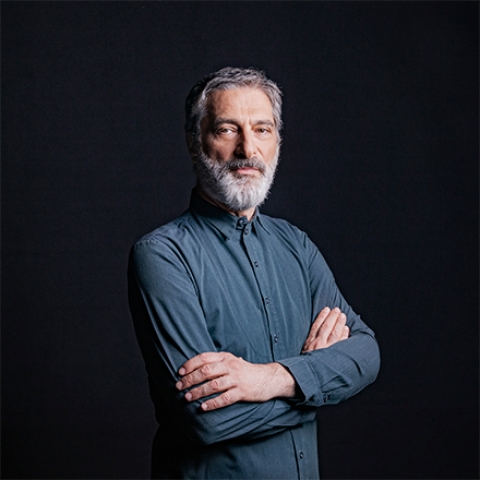
Greek National Opera’s Artistic Director, Giorgos Koumendakis, born in Rethymno, Crete, in 1959, is one of the most gifted and versatile Greek composers. Apart from his numerous pieces of symphonic and chamber music, a large part of his artistic career has been devoted to composing music for the performing arts (theatre, cinema, dance, opera, installations).
He has composed and presented four operas, among which stands out the two-act opera The Murderess (2014, to a libretto by Yannis Svolos, based on Alexandros Papadiamantis' ‘social novella’ under the same title). Commissioned by the Greek National Opera, this work combines the Greek musical tradition with the genre’s contemporary European identity.
Koumendakis’ distinctions date back to 1985, when he was chosen by György Ligeti to compose Symmolpa V. A few months later, he participated in the Venice Biennale. In 1987, he collaborated for the first time with the renowned French ensemble for contemporary music ‘Ensemble InterContemporain’, thus inaugurating an international career that led, in 1992, to the Prix de Rome, an honorary scholarship entailing a year of creative residency at the French Academy in Rome (Villa Medici).
In the same year began his long-standing collaboration with choreographer-director Dimitris Papaioannou and the ‘Edafos Dance Theatre’, which culminated in the opening and closing ceremonies of the Athens 2004 Olympic Games, where Koumendakis served as music director, composer, and author of the musical scenario.
He has collaborated with leading figures in the fields of theatre, opera, and dance, such as Karolos Koun, Stefanos Lazaridis, Yannis Houvardas, Roula Pateraki and Rallou Manou.
He has also served as artistic director of the ‘Nikos Skalkotas’ ensemble, the ‘Kyklos Ensemble’, and the Rethymno Rennaissance Festival, as well as the artistic programme manager for the Cultural Foundation of Tinos.
His works have been performed throughout the world, at prestigious concert halls and opera houses like the Salle Olivier Messiaen, Théâtre de l’Archevêché, Teatro La Fenice, Alte Oper, Benesse Museum (Naoshima), Concertgebouw (Amsterdam), Purcell Room, Wigmore Hall, Carnegie Hall, Forbidden City Concert Hall (Beijing), Muziekgebouw aan't IJ (Amsterdam), Auditorio Nacional de Música (Madrid), Clarice Smith Performing Arts Center (Maryland), Piccolo Teatro (Milan) and the Guarnerius Art Centre (Belgrade).
From 2015 to February 2017, he worked as artistic programme manager of the Greek National Opera’s Alternative Stage, planning innovative programmes and productions based on artistic, educational, and social criteria.

CONDUCTOR
Andreas Tselikas (14, 15, 18, 20, 21/2)
Yorgos Aravidis (22/2 - 17, 19/4)
DIRECTOR
Vassilis Papavassiliou
SETS - COSTUMES
Giorgos Ziakas
MOVEMENT
Fotis Diamantopoulos
LIGHTING
Eleftheria Deko
CHORUS MASTER
Agathangelos Georgakatos
VARONÀS
Pavlos Maropoulos (14, 18, 21/2 - 17/4)
Kostis Rasidakis (15, 20, 22/2 - 19/4)
MR LATROUDIS
Angelo Simo (14, 18, 21/2 - 17/4)
Stamatis Beris (15, 20, 22/2 - 19/4)
MRS LATROUDI
Αlexandra Mattheoudaki (14, 18, 21/2 - 17/4)
Lydia Angelopoulou (15, 20, 22/2 - 19/4)
ΑNNA
Elena Kelessidi (14, 18, 21/2 - 17/4)
Despina Scarlatou (15, 20, 22/2 - 19/4)
ADRIANÒS
Dimitris Paksoglou (14, 18, 21/2 - 17/4)
Nikos Stefanou (15, 20, 22/2 - 19/4)
RITA
Georgia Eliopoulos (14, 18, 21/2 - 17/4)
Μaria Kokka (15, 20, 22/2 - 19/4)
DIMOSTHENIS
Thanassis Dimou (14, 15, 18, 20, 21, 22/2 - 17, 19/4)
POLICE SERGEANT
Kostas Dotsikas (14, 15, 18, 20/2)
Costas Mavrogenis (21, 22/2 - 17, 19/4)
MIMIS
Nikos Tsaousis (14, 18, 21/2 - 17/4)
Anastasios Stellas (15, 20, 22/2 - 19/4)
PETROS
Manolis Lorentzos (14, 18, 21/2 - 17/4)
Stavros Giannoulis (15, 20, 22/2 - 19/4)
With the GNO Orchestra and Chorus
14, 15, 18, 20, 21, 22 February 2015
17, 19 April 2015
Olympia Theatre
New production
Performances begin at 20.00 |

18 April 2015
SNFCC Visitors Center
Starts at 19.00 |
Free admission

CONDUCTOR
Jaroslav Kyzlink (28, 29/3 - 4, 5/4) - Ondrej Olos (1, 3/4)
DIRECTOR
David Pountney
SETS - COSTUMES
Maria Björnson
[by kind permission of Τhe Maria Björnson Archive/www.mariabjornson.com]
LIGHTING
Nick Chelton
CHOREOGRAPHY
Stuart Hopps
REVIVAL DIRECTOR AND CHOREOGRAPHER
Elaine Tyler-Hall
CHORUS MASTER
Agathangelos Georgakatos
CHILDREN'S CHORUS MISTRESS
Mata Katsouli
FORESTER
Randall Jacobs (28/3 - 3, 5/4)
Petros Salatas (29/3 - 1, 4/4)
FORESTER’S WIFE
Ines Zikou (28/3 - 3, 5/4)
Εleni Davou (29/3 - 1, 4/4)
SCHOOLMASTER
Charalambos Alexandropoulos (28/3 - 3, 5/4)
Yannis Filias (29/3 - 1, 4/4)
PARSON
Dimitris Kassioumis (28/3 - 3, 5/4)
Petros Magoulas (29/3 - 1, 4/4)
HARAŠTA, PEDLAR
Haris Andrianos (28/3 - 3, 5/4)
Akis Lalousis (29/3 - 1, 4/4)
PÁSEK, INNKEEPER
Yannis Filias (28/3 - 3, 5/4)
Filippos Dellatolas (29/3 - 1, 4/4)
INNKEEPER’S WIFE / OWL
Voula Amiradaki (28/3 - 3, 5/4)
Barunka Preisinger (29/3 - 1, 4/4)
VIXEN
Mina Polychronou (28/3 - 3, 5/4)
Gina Fotinopoulou (29/3 - 1, 4/4)
FOX
Elena Kelessidi (28/3 - 3, 5/4)
Gina Poulou (29/3 - 1, 4/4)
YOUNG VIXEN
Νiki Chaziraki (28, 29/3 - 1, 3, 4, 5/4)
FRANTÍK
Miranda Makrinioti (28, 29/3 - 1, 3, 4, 5/4)
PEPÍK
Filli Georgiadou (28/3 - 4, 5/4)
Ζoe Kappou (29/3 - 1, 3/4)
LAPÁK, THE DOG
Arkadios Rakopoulos (28, 29/3 - 1, 3, 4, 5/4)
ROOSTER
Stamatis Beris (28, 29/3 - 1/4)
Μanolis Lorentzos (3, 4, 5/4)
CHOCHOLKA, A HEN
Alexandra Mattheoudaki (28/3 - 3, 5/4)
Lydia Angelopoulou (29/3 - 1, 4/4)
WOODPECKER
Lito Messini (28, 29/3 - 1, 3, 4, 5/4)
MOSQUITO
Thanassis Evangelou (28/3 - 3, 5/4)
Aris Prospathopoulos (29/3 - 1, 4/4)
BADGER
Ζafeiris Koutelieris (28, 29/3 - 1/4)
Christos Lazos (3, 4, 5/4)
JAY
Vassia Zacharopoulou (28, 29/3 - 1, 3, 4, 5/4)
With the GNO Orchestra, Chorus and members of the GNO Children's Chorus, in the framework of its educational programme as well students of the GNO Dance School
28, 29 March 2015
1, 3, 4, 5 April 2015
Οlympia Theatre
First staging by the Greek National Opera - Production originated at Welsh National
Opera and Scottish Opera
Performances begin at 20.00 |
5 April 2015
Olympia Theatre's Foyer
Performances begin at 18.00 |
General admission: 5€

5 April 2015
SNFCC Visitors Center
Starts at 19.00 |
Admission is free

DIRECTION
Angela-Kleopatra Saroglou
SETS
Yorgos Kollios
COSTUMES
Alexia Theodoraki
LIGHTS
Spyros Tzoras
PIANO
Yiannis Tsanakaliotis
DON JOSÉ
Dimitris Paksoglou
ESCAMILLO/MORALLÈS
Dionyssis Tsantinis
ZUNIGA/LE DANCAÏRE
Giorgos Mattheakakis
CARMEN
Marissia Papalexiou
MICAËLA/FRASQUITA
Despina Skarlatou
MERCÉDÈS
Maria Vlachopoulou
3 April 2015
INTERNATIONAL EXHIBITION CENTRE, KASTORIA
Performances begin at 20.00 |
Free entrance for priority pass holders. Priority passes will be distributed one hour prior the starting time
[Carmen at a glance]
The composer / French composer Georges Bizet was born in Paris, in 1838 and died in Bougival, near Paris, in 1875. His first music teacher was his father, a vocal coach. Later, he studied at the Conservatoire de Paris, under Jacques Fromental Halévy, composer of the opera La Juive and whose daughter Bizet married in 1869. Apart from his studies at the Conservatoire, Georges Bizet also studied under Charles Gounod and was profoundly influenced by him. When in 1857 Bizet won the prestigious Grand Prix de Rome, he had already composed the noteworthy Symphony in C, which was performed for the very first time as late as 1935! The arrangement of his poor financial state was the first thing he did upon his return to Paris from the Villa Medici. His opera Les pêcheurs de perles (1863) was not as successful as anticipated. Following the Franco-Prussian War (1870), he was appointed chorus master at the Opéra de Paris, but he opted for the position of the rehearsal pianist & répétiteur at the Opéra Comique. In 1872 he scored his first great success thanks to the music he composed for the theatrical play L'Arlésienne, based on the eponymous novel by Alphonse Daudet. In March 1875 he experienced the tumultuous premiere of his Carmen, but did not enjoy the work’s huge recognition for he died only a few months later, at the age of 37.
The opera / Carmen is a four-act French opera and belongs to the genre opéra comique. It is based on a libretto written by Henry Meilhac and Ludovic Halévy, based on Prosper Mérimée's namesake novel (1845). The term opéra comique does not suggest the existence of comic elements, but relates to structural and aesthetical features, one of which being spoken dialogues. In 1875, on the occasion of presenting Carmen in Vienna, Ernest Guiraud replaced the dialogues with recitatives. Also, he added some dance scenes by borrowing music from the suite L'Arlésienne and from Bizet's opera La jolie fille de Perth.
Premieres / Carmen first premiered in Paris at the Salle Favart. It was staged by the Opéra Comique on 3 March 1875. The leading role was performed by Célestine Galli-Marié. The performance staged in Vienna (October 1875) was pivotal as to the acknowledgment of the opera. Carmen was included in the repertoire of the Greek National Opera in 1941-2, with Kitsa Damasioti as Carmen and Antonis Delendas and Nikos Glinos at the role of José, Fani Aidali as Micaëla and Spyros Kalogeras as Escamillo. Antiochos Evangelatos was the conductor.
Act I / At a café in a square of Seville, soldiers comment leisurely on the passers-by while waiting for Carmen who works nearby to show up. Eventually, Carmen comes and almost threatens her admirers by singing a song about the fickle nature of love. Reacting to Zuniga's persistent flirt, she takes refuge to Don José by kissing him in a provocative manner and throwing him a flower. Although Don José seems to be annoyed, he keeps the flower. Carmen and Mercédès return to work. Micaëla enters the stage and gives José a kiss and a letter from his mother. In the letter his mother designates Micaëla as a suitable wife for him. Voices are heard, Carmen and Zuniga enter the stage again, but this time in dispute. Carmen keeps a suspicious object in her bag, but she won't give any explanations. Zuniga asks Don José to lead her to prison. Once they are left alone, Carmen charms the officer and in exchange of liberating her she pledges her love to him. Don José helps her escape.
Act II / In a bar. Carmen and Mercédès work night shift. Escamillo, the famous toreador, arrives. Carmen seems to be disinterested, but she lets him hope. Don José arrives and Carmen joyously dances for his sake. When he explains to her that duty calls him and has to leave, Carmen is outraged; she remains unmoved both at the view of the flower of their first encounter and by his marriage proposal. As she explains, if he loves her, he must leave her and make a fresh start someplace else. The lieutenant of the guards (Zuniga) returns hoping to find Carmen alone. Don José, jealous of Zuniga, attacks him. Now he has no other choice but to follow Carmen.
Act III / In a deserted place where Carmen and Don José have taken refuge. Micaëla comes dispirited only to inform Don José that his mother is dying. When she perceives that someone is following her, she hides. The person following her is Escamillo who has come to claim Carmen. Don José is furious and challenges him in a duel. At this point Carmen interrupts them and Escamillo invites everyone to his next bullfighting. Micaëla turns up informing Don José that his mother is on her death bed. He threatens Carmen and follows the girl. Carmen is mesmerised by Escamillo and follows his voice.
Act IV / In Escamillo's dressing room. Carmen helps him in his preparations for the arena. Escamillo bids her a warm goodbye and enters the arena. Carmen is left alone and watches the bullfighting on a monitor. Don José rushes in and insists on her following him. She openly tells him that she does not love him and that she would rather die than losing her freedom. Through the arena she can hear the cheering crowd and she is about to dash and take a taste of Escamillo's triumph, but Don José stands in her way. She gives him back the ring he had given her as a token of his love and kills her the very moment the bull strikes a deadly blow at Escamillo.
Director's note / Although today Carmen is synonymous with Spain, nobody remembers that its composer had never visited the Iberian Peninsula before composing this work that was to reserve him a place amongst the most celebrated opera composers. In the abridged version of the work we prepared for the Suitcase Opera, our aim was to narrate the story from a different angle with regard to Spain and its particular character. We kept intact the opera's dramatic core in which the dynamic rapport that develops among the main characters is skilfully outlined through music and dramatic performance. However, the grand spectacle and the vivid, crowded scenes were left out. In essence, every abridged version is a new creation. Consequently, our intent was to place our own Carmen in the Spain of the 1990s, in Seville; a city whose history is always evident and where the past encounters the present, and both engage in a discourse with daily life.
Almodovar's films are our focal point of reference as far the aesthetics are concerned. Through his cinematography we saw Spain from a different viewpoint and we became familiarised with the country, perhaps more than Bizet was in his time. Our version presents two different worlds that meet and eventually come into conflict: on the one hand we see the conservative, Catholic and provincial Spain (especially Southern Spain); on the other hand there is the emancipated Spain and its big cities of the post-Franco era, the way it is depicted in Almodovar's films. The gypsy element was consciously omitted from our narration because in the past it bore different connotations from today and especially because in the original text it is used as an explanation for the deviant nature of Carmen and her comrades. Our decision to dispense with this outdated pseudo-exotic element did not emerge from the need to be politically correct, but rather from our choice to be more loyal to the spirit of the work and our decision to depict Carmen as a contemporary woman who is trying to survive by working day and night. She is a woman who knows the nitty-gritty of the world both under the bright light of day and in the darkness of night, making her a lot more experienced than Don José who grew up in a safe bourgeois environment. Carmen does not aspire to have a family and children; she knows that her desires would cost her dearly. However, she had never imagined the price would be so high…

Greek bass, he was born in Athens. Ηe studied advanced music theory and violin at the Olympic Conservatory, Athens, and singing at the National Conservatory, Athens. He has attended voice master classes. As a soloist he has performed in concerts of symphonic and choral music. Since 1997 he has been a permanent member of the Greek National Opera Chorus, participating in almost all productions. Moreover, he has sung soloist roles in numerous operas such as Madama Butterfly, Gianni Schicchi, Rigoletto and sang the part of the Monk in Paolo Carrer’s opera Frossini (in concert, 2021).

Greek bass, he graduated from the Music School of Pallini and studied singing (diploma with honours and first prize) under Rossitza Troeva. He has performed in concerts in Greece, The Netherlands and Bulgaria. He has been a member of the Greek National Opera Chorus since 2012, having singing such roles as Colline (La bohème), Masetto and Commendatore (Don Giovanni, “The Suitcase Opera”), as well as Don Basilio (Il barbiere di Siviglia), as part of the educational project of the Greek National Opera “Interactive Opera for Primary Schools”.

Greek bass-baritone, he was born in Athens. He studied voice next to internationally acclaimed singers. He began his studies with tenor Pavlos Raptis at the Hellenic Conservatory and continued with Kostas Paskalis, Frangiskos Voutsinos, George Pappas (diploma with honours and first prize), George Zervanos and Lazaros Tselepides. He has attended seminars and masterclasses under famous soloists such as Aris Christofellis and Ghena Dimitrova. As a grant-holder of the Mozarteum Academy of Music and Performing Arts in Salzburg, he studied next to baritone Rudolf Knoll and in Italy with Mauro Augustini, Gianfranco Cecchele, Gianni Maffeo and Bonaldo Giaiotti. He has worked with the Hellenic Broadcasting Corporation and since 1998 he has been a permanent member of the Chorus of the Greek National Opera.
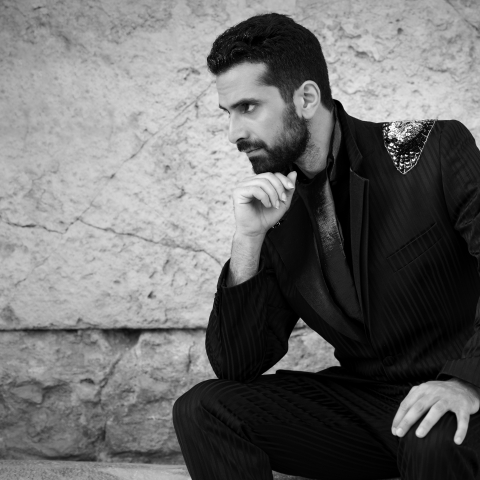
Greek baritone, he was born in Athens and graduated from the Department of Philology (Linguistics) at the School of Philosophy (NKUA). He obtained a diploma in monody under Mechthild Stamataki. In 2005, he began his collaboration with the Greek National Opera, participating as a soloist in the children’s production Orpheus by Offenbach, and later as an additional chorister, whilst he was a member of the Hellenic Broadcasting Corporation Chorus (2006–2011), taking part in numerous productions in Greece and abroad. Since 2011 he has been a permanent member of the Greek National Opera Chorus, where he has also performed minor roles. In 2016/17, he participated in Zachos Terzakis’ opera workshop, where he sang the role of Guglielmo (Così fan tutte, Mozart). As a member of the programme ‘Youth Opera’, he interpreted the role of Michele (Il tabarro, Puccini, 2018) and has also sung in various opera galas. He has attended masterclasses with distinguished soloists, participates in recitals and concerts, and is also involved in guitar, composition, music production and photography.
STAVROS NIARCHOS FOUNDATION
CULTURAL CENTER
364 Syggrou Avenue, Kallithea
Box Office:
+30 213 0885700
Box Office email:
boxoffice@nationalopera.gr
Daily 09.00-21.00
info@nationalopera.gr