


























Contact
ADDRESS
STAVROS NIARCHOS FOUNDATION
CULTURAL CENTER
364 Syggrou Avenue, Kallithea
TEL.
Box Office:
+30 213 0885700
Box Office email:
boxoffice@nationalopera.gr
Daily 09.00-21.00
info@nationalopera.gr
Register to our Newsletter






Conductor: Paolo Carignani
Stage direction: Stephen Langridge
Revival stage director: Katerina Petsatodi
Sets, costumes: George Souglides
Movement: Dan O’Neill
Lighting: Peter Mumford
Chorus master: Agathangelos Georgakatos
Children’s chorus mistress: Konstantina Pitsiakou
Sir John Falstaff
Tassis Christoyannis
Ford
Dionysios Sourbis
Fenton
Vassilis Kavayas
Dr Caius
Andreas Karaoulis
Bardolfo
Yannis Kalyvas
Pistola
Haris Andrianos
Alice Ford
Cellia Costea
Nannetta
Marilena Striftobola
Mistress Quickly
Nefeli Kotseli
Meg Page
Chrysanthi Spitadi
With the Orchestra, Chorus, and Children’s Chorus of the GNO (as part of its educational mission)
Ticket prices: €15, €20, €35, €40, €55, €60, €65, €90
Students, children: €15
Limited visibility seats: €10
Opera • Revival
GNO Stavros Niarchos Hall – SNFCC
Starts at: 19.30 (Sunday: 18.30) | 
Lead Donor of the GNO
The comic opera Falstaff returns for six unique performances on 15, 18, 21, and 26 February, and 1 and 5 March 2026 at the Greek National Opera. Verdi’s swan song is brought to life under the highly successful stage direction of Stephen Langridge, renowned director and Artistic Director of the famous Glyndebourne Opera Festival. Katerina Petsatodi is responsible for reviving the original direction. The prominent Italian conductor Paolo Carignani will be leading the orchestra. Making his debut in the title role at the GNO will be the internationally acclaimed Greek baritone Tassis Christoyannis.
Verdi surprised everyone with his final opera, Falstaff—based on Shakespeare’s play The Merry Wives of Windsor—as not many believed the then 80-year-old composer had another major work in him (and a comedy at that!) following the huge success of his Otello (1887). The work—first presented at La Scala in Milan on 9 February 1893—would prove a brilliant conclusion to his career as an opera composer.
Central to the action is the washed-up old knight Sir John Falstaff, whose romantic misadventures make him a laughingstock in the provincial society of his small town. In the end, after a series of tragicomic situations have unfolded, all the work’s characters sing the following refrain together: ‘The whole world’s a farce… but he who laughs last, laughs best.’
The opera has justly been called a masterpiece of the genre for its expressive economy and concise form—for its composer’s ability to encapsulate entire characters and situations with a single musical phrase. Indeed, the majority of the work is marked by sustained and often blistering shifts in tempo and tone, and between short melodic themes or harmonies. Verdi avails himself of a vast palette in order to render the various facets of Falstaff, who is the opera’s only true lead role, around which everyone else revolves. In his two monologues, Falstaff condemns the world as unfair and lectures on morality, and goes on to appear before Alice as a great heartbreaker, and before her husband, Ford, as a vain knight, before ending up a laughingstock in the forest scene.
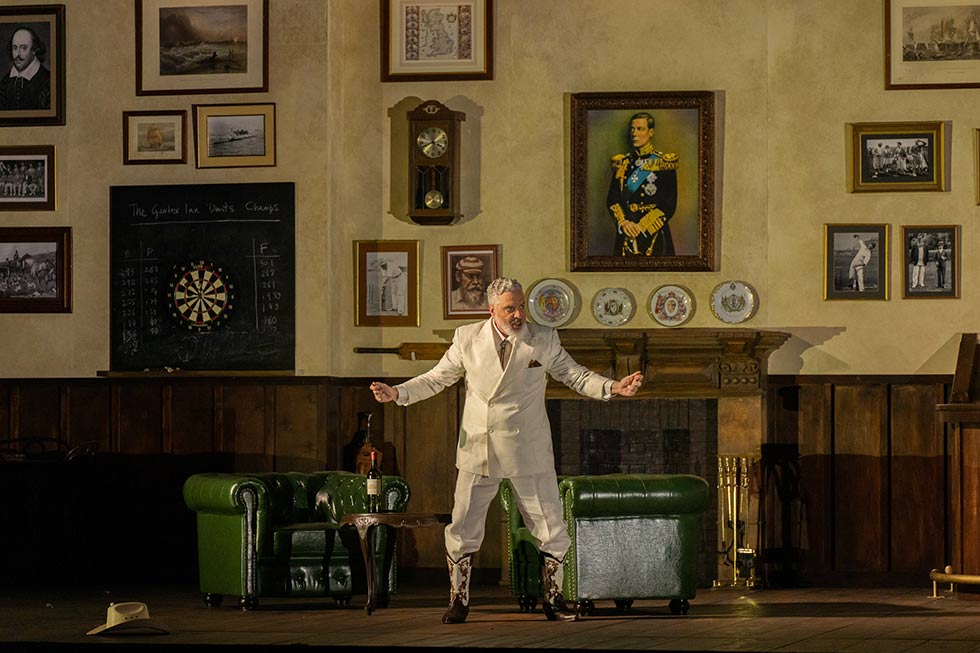
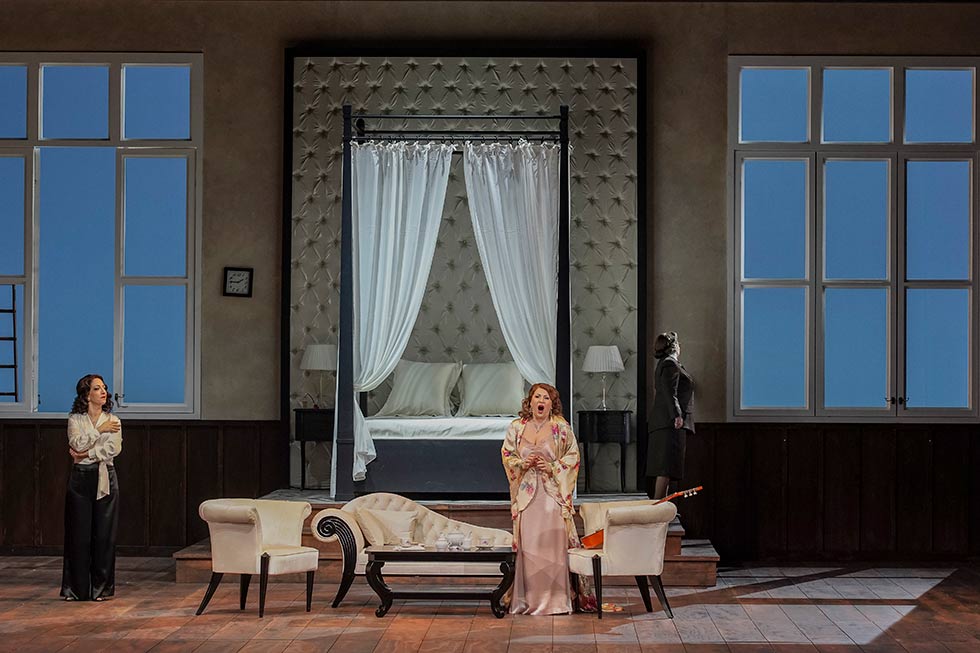
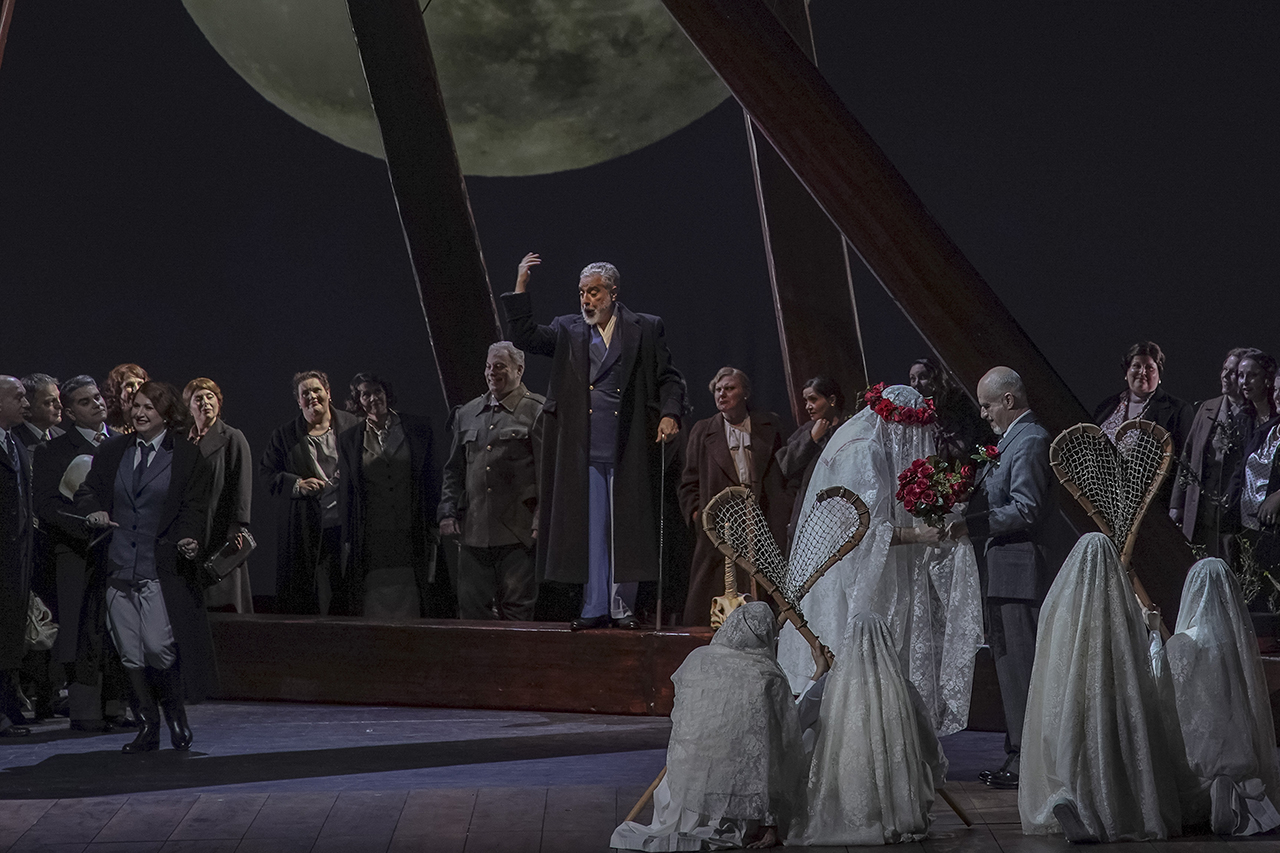
The successful staging, first performed at the Greek National Opera during the 2022/23 season, bears the stamp of internationally acclaimed British director Stephen Langridge. Katerina Petsatodi is responsible for reviving the direction. Langridge shifts Falstaff’s story to 1930s England, a period marked by the absurdity of social hierarchy, bordering on feudalism. As the director notes, ‘our production is set in England in the 1930s. A time between the wars (Falstaff was an old soldier), with a scandalous Prince of Wales (like Hal in Henry IV) who will briefly become King Edward VIII, and a time when the hierarchies are rigid, with social class more respected than money. Falstaff is based on Shakespeare’s only fully English comedy, but the end is pure Verdi / Boito. “Tutto nel mondo è burla” (All the world’s a farce) is their conclusion—and when we look around us at today’s chaotic world, we can only agree, and then perhaps head off to the pub for a pint of warm ale and a laugh with Sir John!’
Distinguished Greek set and costume designer George Souglides has created stunning sets and costumes that capture 1930s England, in line with the director’s vision. Responsible for the movement direction is Dan O’Neill, and the lighting has been designed by Peter Mumford.
The Greek National Opera Orchestra will be led by the renowned Italian conductor Paolo Carignani, a favourite among GNO audiences for his previous collaborations on Nabucco, La forza del destino, and the recent production of Tosca.
The title role will be performed by Tassis Christoyannis, a renowned lead and Artistic Director of the Olympia City Music Theatre ‘Maria Callas’. Christoyannis has starred in productions at the Greek National Opera since 1989 and regularly performs at some of the world’s most prestigious theatres, including the Opéra-Comique, the Opéra national de Paris, the Théâtre des Champs-Élysées in Paris, the Royal Opera House in London, and others.
The leading roles are performed by distinguished soloists from the Greek National Opera: Dionysios Sourbis, Vassilis Kavayas, Andreas Karaoulis, Yannis Kalyvas, Haris Andrianos, Cellia Costea, Marilena Striftombola, Nefeli Kotseli, and Chrysanthi Spitadi.
The GNO Chorus has been prepared by Agathangelos Georgakatos, and the GNO Children’s Chorus by Konstantina Pitsiakou.
STAVROS NIARCHOS FOUNDATION
CULTURAL CENTER
364 Syggrou Avenue, Kallithea
Box Office:
+30 213 0885700
Box Office email:
boxoffice@nationalopera.gr
Daily 09.00-21.00
info@nationalopera.gr