































Contact
ADDRESS
STAVROS NIARCHOS FOUNDATION
CULTURAL CENTER
364 Syggrou Avenue, Kallithea
TEL.
Box Office:
+30 213 0885700
Box Office email:
boxoffice@nationalopera.gr
Daily 09.00-21.00
info@nationalopera.gr
Register to our Newsletter





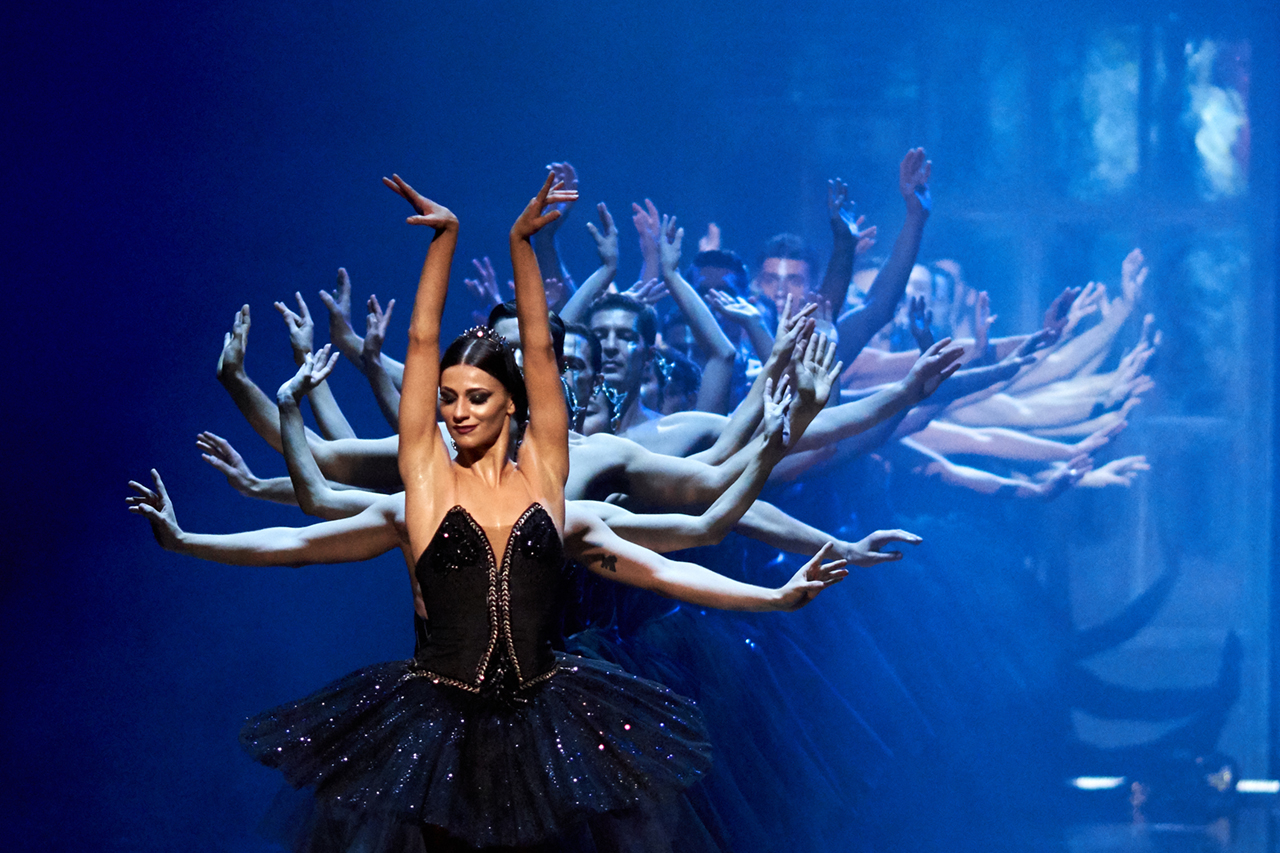

The performances of the ballet Swan Lake will be fully accessible on the 27th & 28th of March 2026
Choreography, stage direction, sets: Konstantinos Rigos, with references to the choreographies of Marius Petipa and Lev Ivanov
Original musical composition: Ted Regklis
Conductor: Philippe Forget
Dramaturgy consultant: Alexandros Efklidis
Costumes: Giorgos Segredakis
Lighting: Christos Tziogkas
Associate architect: Mary Tsagari
Siegfried
Dmitry Zagrebin (07, 08/03), Charles - Louis Yoshiyama (22, 27, 28/03), Constantine Allen (15/3, 04/4)
Odette - Odile
Ksenia Ovsyanick (22, 27, 28/3), Rachele Buriassi (15/3, 04/4)
Odette
Rachele Buriassi (7, 8/3)
Odile
Eleana Andreoudi (7, 8/3)
Siegfried’s tutor
Danilo Zeka / Yannis Mitrakis
The Queen
Christina Makridou / Popi Sakellaropoulou
Rothbart
Igor Siadzko / Angelos Antoniou
Jester
Yorgos Hatzopoulos
A friend of Siegfried
Elena Kekkou
Siegfried’s first friend
Vangelis Bikos
Siegfried’s second friend
Yannis Gantsios
Featuring the Orchestra, Principal Dancers, Soloists, Demi-Soloists, and the Corps de ballet of the Greek National Opera
Ticket prices: €15, €20, €30, €35, €42, €50, €55, €70
Students, children: €12
Limited visibility seats: €10
Ballet • Revival
GNO Stavros Niarchos Hall – SNFCC
Starts at: 19.30 (Sunday: 18.30) | 
Lead Donor of the GNO
Ballet sponsor

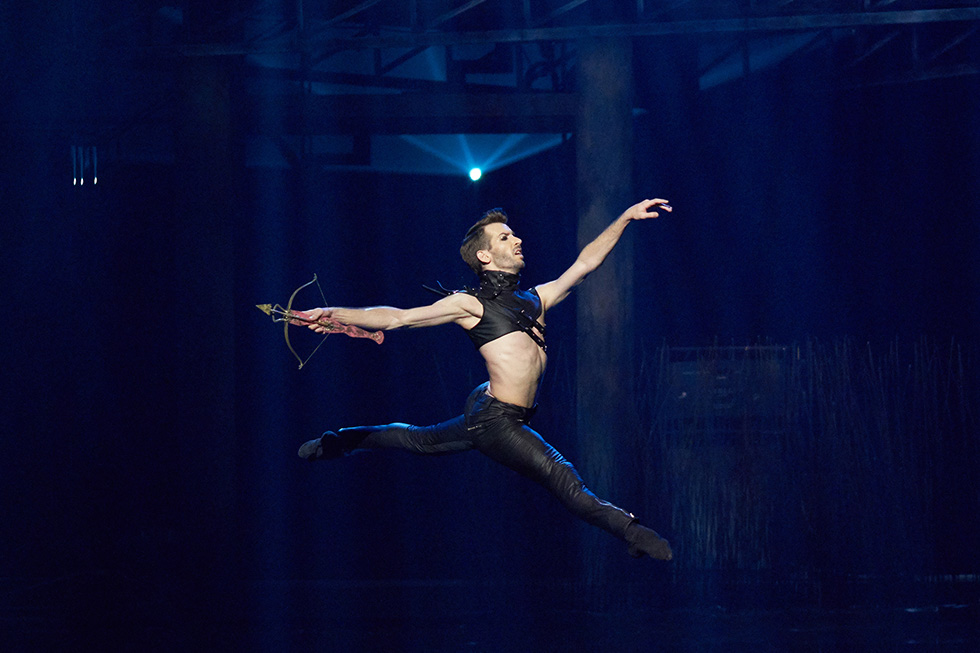
Swan Lake, the most famous ballet of all time, returns for seven unique performances by the Greek National Opera Ballet in a new version of Konstantinos Rigos’ highly successful choreography. The performances will take place on 8, 15, 22, 27, 28 March and 4 April 2026, in the Stavros Niarchos Hall at the SNFCC, conducted by Philippe Forget, and featuring a cast of international ballet stars.
Tchaikovsky’s Swan Lake has long enthralled and moved audiences, while also posing a challenge for dancers, as the virtuosic skills and lyricism required for a complete interpretation of this work often seem to transcend human limits. At the same time, it is also a musical work of immense performative demands.
Konstantinos Rigos revisits Tchaikovsky’s classic masterpiece, raising new questions about how major works of the classical ballet repertoire can be reinterpreted today. Petipa and Ivanov’s original choreography dominates the lake’s landscape, like a ritual repeated in a timeless setting. By creating a choreographic palimpsest, the dancers alternate between the classical style and other choreographic forms, ranging from neoclassical to modern dance.
Stamping his mark on the choreography, stage direction, and sets, Konstantinos Rigos explores some of our era’s fears and obsessive images to immerse himself in his own lake. A landscape in a post-destruction era. A lake where the natural and the supernatural co-exist and alternate.
Konstantinos Rigos notes: “In this new, revised version of Swan Lake–eight years after its premiere—I revisit a symbolic work, aiming to delve deeper into the core of its romanticism. The choreography is born of an intense fascination with lyricism, flirting with the enduring charm of classical ballet and the delicate freedom of neoclassical elements, where the ideal intersects with the human. The characters retain the recognisable traits of the classical narrative, but their roles shift: they serve as reflections of the prince’s inner world. The white and black swans are no longer rival entities; instead, they represent two sides of the same figure—light and darkness, purity and desire, hope and fall. Through this duality, I intend to showcase the hero’s inner struggle, a deeply romantic struggle, in which the soul seeks idealisation, fully aware that the price is often loss. Although Swan Lake is set against a harsh landscape of abandonment, the performance transforms it into a realm of dreams and memories, a poetic mirror of the human desire for absolute love and transcendence.”
The GNO Orchestra will be led by the acclaimed conductor and composer Philippe Forget, who has been anointed as a Knight of the Order of Arts and Letters in France. The artistic director of the Labeaume en Musiques Festival returns to the GNO podium after the fascinating dance performance Tchaikovsky, which explores the life of the great Russian composer Pyotr Ilyich Tchaikovsky in 2025.
Ted Regklis has composed an original music score for this production, while Alexandros Efklidis serves as a dramaturgy consultant. The costumes are designed by George Segredakis, and the sets by associate architect Mary Tsagari. Responsible for the lighting is Christos Tziogkas.
Alongside the exceptional Principal Dancers, Soloists, Demi-Soloists, and the Corps de ballet of the GNO, the production also features star dancers from the international ballet scene.
The leading role of Odette / Odile will be shared by Ksenia Ovsyanick and Rachele Buriassi.
Internationally sought-after British-Belarusian dancer Ksenia Ovsyanick returns to the GNO, just two months after her highly successful performance as Giselle. A Principal Dancer with the Berlin State Ballet and the National Polish Ballet, she began her career with the National English Ballet. In her hitherto remarkable journey, she has performed roles from both the classical and modern repertoires and has collaborated with leading international choreographers.
Rachele Buriassi was born in Sarzana, Italy. In 2006, she joined the prestigious Stuttgart Ballet, and the Boston Ballet in 2015. Since 2019, she has been a Principal Dancer with the Grands Ballets Canadiens. The multi-awarded dancer, known to the GNO audience for her role in the successful 2024 production of Don Quixote, teaches and performs as a guest dancer in performances worldwide. She has an extensive repertoire, featuring leading roles in productions by renowned choreographers and in classical works.
Performing as Odile for two exclusive performances will also be the Principal Dancer from the GNO, Eleana Andreoudi. Since 2018, she has embarked on an international career, serving as a Principal Dancer at the Arena di Verona in productions of Aida and La traviata, where she received outstanding reviews. She also participates in international galas and performances worldwide. She has been awarded first prizes at various international competitions, including the Grand Prix, and has received several honorary distinctions.
In the role of Siegfried, we will have the chance to enjoy Dmitry Zagrebin, Charles-Louis Yoshiyama and Constantine Allen.
Russian dancer Dmitry Zagrebin was born in Moscow into a family of former Bolshoi Ballet dancers. Following in their footsteps, he studied at the prestigious Bolshoi Ballet Academy and joined the Bolshoi Ballet in 2007. In 2015, he became a Soloist with the Royal Swedish Ballet and was soon promoted to Principal Dancer, a position he has held ever since. His repertoire includes leading roles in both classical and contemporary ballet, such as Rudolf Nureyev’s Don Quixote, and Natalia Makarova’s Giselle, among others. He has received numerous international awards, including gold medals at the International Ballet Competitions in Seoul and Moscow.
The Japanese-French Charles-Louis Yoshiyama is a Principal Dancer with the Zurich Ballet. He studied dance at Trinity College London and the English Ballet School. In 2007, he joined the Houston Ballet and was promoted to Principal Dancer in 2016. He has performed leading roles, such as Crown Prince Rudolf in Kenneth MacMillan’s Mayerling, De Grieux in Manon, and Oberon in John Neumeier’s A Midsummer Night’s Dream, among others. He has also danced in numerous works by George Balanchine.
The American of Greek descent Constantine Allen is a Principal Dancer with the Dutch National Ballet. He attended dance classes in Hawaii until he turned twelve, when it became clear that to receive a quality education, he had to study abroad. Among his numerous awards and distinctions, the Grand Prix at the Tanzolymp Festival in Berlin (2011) was the one that established him internationally. He has performed as Principal Dancer with the Stuttgart Ballet, as well as with the Grand Ballets Canadiens. He has also danced major leading roles, including Count Albrecht in Giselle and Siegfried in Swan Lake.
The production features the GNO Ballet dancers Danilo Zeka, Yannis Mitrakis, Christina Makridou, Popi Sakellaropoulou, Igor Siadzko, Angelos Antoniou, Yorgos Hatzopoulos, Elena Kekkou, Vangelis Bikos, and Yannis Gantsios.
With the Orchestra, Principal Dancers, Soloists, Demi-Soloists, and the Corps de ballet of the GNO.
Swan Lake at a glance
The composer / The Russian composer Pyotr Ilyich Tchaikovsky (1840–1893) is one of the most popular musical figures of the 19th century. He composed equally successful symphonies, concertos, operas, chamber music, as well as music for ballets such as Swan Lake (1870), The Sleeping Beauty (1890), and The Nutcracker (1892). These three ballets remain the most popular in the repertoire to this day, due to the emotional power and dramatic impact of their music—characteristics that allowed ballet music to be valued on its own terms as a symphonic work. These very elements, which run through Tchaikovsky’s entire body of works, have also inspired many choreographers to create new works for ballet, based on his music. Therefore, it is not coincidental that Tchaikovsky’s name has been associated with the art of dance, probably more than that of any of his other colleagues.
The work / Originally in four acts, Swan Lake was based on a choreography by Julius Reisinger. His choreography was, in turn, inspired by a scenario from Vladimir Petrovich Begichev and Vasily Geltser that draws on German and Russian folk tales. According to the original plot, Princess Odette was transformed into a swan by the evil sorcerer Rothbart. The spell can only be broken if someone swears to love Odette forever. Prince Siegfried is the one to promise eternal love. Yet, at a reception in his palace, Rothbart introduces his daughter Odile, whom he has transformed so that she looks identical to Odette. Unaware, Siegfried dances with Odile and promises to marry her. When he realises his mistake, he returns to the lake, where Odette forgives him. Yet, Rothbart appears, insisting that Siegfried should keep his word and marry Odile. Siegfried prefers to die at Odette’s side. The spell is broken, Rothbart loses his power, and dies. Siegfried and Odette ascend to heaven together, forever united in love.
Premieres / Swan Lake was premiered by the Bolshoi Ballet in Moscow on 4 March 1877. Marius Petipa and Lev Ivanov revived the work for the Imperial Ballet, staging it at the Mariinsky Theatre in Saint Petersburg on 27 January 1895. For that production, Tchaikovsky’s score was revised by Riccardo Drigo, the chief conductor and composer of the Imperial Ballet. Many of the ballet’s subsequent revivals have been based on that version.
Fully accessible performances
The performances of the ballet Swan Lake will will be fully accessible on the 27th & 28th of March 2026, providing an inclusive audiovisual experience for all audiences. In this context, there will be designated seats for individuals who are deaf or hard of hearing and use Greek Sign Language, places for those who rely on captions (CAPS) covering the entire audio channel, as well as seats for individuals who are blind or have limited access to the visual channel of communication and use the audio description (AD) service. Guide dogs for the visually impaired will also be permitted.
Audience members who wish to use the accessibility services are requested to purchase their tickets at the GNO Box Office, over the phone at 2130885700, or via email at This email address is being protected from spambots. You need JavaScript enabled to view it..
The full accessibility services for this production are included in the accessibility initiative cycle Altogether at the Opera, implemented with the support of Alpha Bank, as part of its Corporate Responsibility Initiative Culture for All.

STAVROS NIARCHOS FOUNDATION
CULTURAL CENTER
364 Syggrou Avenue, Kallithea
Box Office:
+30 213 0885700
Box Office email:
boxoffice@nationalopera.gr
Daily 09.00-21.00
info@nationalopera.gr