




















Contact
ADDRESS
STAVROS NIARCHOS FOUNDATION
CULTURAL CENTER
364 Syggrou Avenue, Kallithea
TEL.
Box Office:
+30 213 0885700
Box Office email:
boxoffice@nationalopera.gr
Daily 09.00-21.00
info@nationalopera.gr
Register to our Newsletter






Greek translation: Ioanna Meitani
Music: Kharálampos Goyós
Stage director: Savvas Stroumpos
Set & costume designer: Katerina Papageorgiou
Lighting designer: Kostas Bethanis
Dramaturgical consultant: Maria Sikitano
Cast: Evelyn Assouad, Elpiniki Marapidi, Rosy Monaki, Stavros Papadopoulos
Musicians from the Ergon Ensemble
Kostas Tzekos clarinet
Andreas-Roland Theodorou trombone
Vasilis Soukas violin
Pericles Sioundas accordion, vocalist
Ticket prices: €15, €20 • Students, children: €10
Music theatre • New production • National Premiere
Greek National Opera Alternative Stage – SNFCC
Starts at: 20.30 (Sunday: 19.30)
Running time: approximately 120 minutes, no intermission
With English surtitles
Alternative Stage Founding Donor
Major Sponsor of the Greek National Opera

Franz Kafka’s final novel, Josephine the Singer or The Mouse Folk, is adapted into a music theatre performance through a new, ambitious production by the GNO Alternative Stage. The music was created by distinguished composer Kharálampos Goyós, while the direction bears the mark of Savvas Stroumpos, known for his profound theatrical language and the intense physicality of his stage writing. The work will debut on 27 March and run for six performances until the 4th April at the GNO Alternative Stage, at the SNFCC, featuring actors from Zero Point Theatre and musicians from the contemporary music ensemble Ergon Ensemble.
In the short story Josephine the Singer or The Mouse Folk (1924), Kafka transports us to a strange world where there is no youth, not even a brief childhood, as everything is determined by the struggle to survive, and children don’t have the time to be children. In this world, the kind of joy that comes from music never appears; singing has ceased to exist, and whistling is the only form of expression.
Female mouse Josephine, however, introduces an enchanting and captivating type of whistling into this world. Her ecstasy is what makes her whistling irresistible and unique – this odd Kafkaesque singer carries the ecstatic element in the most challenging moments for the mouse folk. Through her bizarre art, she creates a music-like call for revolt, aiming to reclaim life itself.
The performance attempts to shed light on the peculiar, underlying, and sarcastic humour that runs through Kafka’s tragic vision through a musical dramaturgy inspired by the “low”, both carnival-like and, at times, infringing, tradition of light music theatre and vaudeville.
Beneath the Kafkaesque universe
Franz Kafka’s strange and poetic world is imbued with the writer’s specific anguish over the precariousness of the human condition, which is constantly undermined by an unpredictable and profane humour filled with sarcasm and self-sarcasm. His last short novel, Josephine the Singer or The Mouse Folk (1924), is the utmost radical embodiment of the negative aesthetic that runs through his entire body of work. Written from the perspective of a writer who is aware that his time is running out, the text can be read both as the conclusion of Kafka’s work and as an early detector of ruptures in the modernist condition: between voice and meaning, the individual and the community, art and life, memory and oblivion.
The story is recounted by the mouse community and focuses on Josephine, a female mouse who believes she has a unique, exceptional voice. Although the mouse folk are not music enthusiasts and are constantly struggling to survive, crowds gather to listen to her sing. The narrator observes that Josephine’s “singing” is essentially no different from the typical whistling of all mice. However, her performances evoke a sense of collective peace and solemnity during times of social crises.
Josephine is convinced of how incredibly important she is to her folk and demands to be officially granted exemption from her daily duties so she can dedicate herself exclusively to her art. The authorities repeatedly reject her demands, viewing her art as a luxury rather than a necessity. In her effort to pressure the audience into complying with her demands, Josephine employs different tactics: she shortens her performances, pretends to be injured, and eventually disappears completely.
The community does not back down after her disappearance. Life goes on without her, and the narrator draws the conclusion that Josephine will soon be forgotten, as she will be absorbed into her folk’s anonymous, collective history. Her absence ultimately proves that, although the community appreciated her presence, her art was not a condition for her folk’s survival.
Α-music for Josephine
In his new collaboration with the GNO Alternative Stage, following the presentation of his groundbreaking opera of the absurd, Anthony’s Death (2022), distinguished composer Kharálampos Goyós takes on the challenging task of composing music for the performance Josephine the Singer or The Mouse Folk, a work centered on the concept of amusia. The production’s score combines “handmade” and analog “loops” from instruments, resembling a kind of primitive “techno” music, with organized fragments from authentic methods of learning musical instruments, rhythmic choral storytelling, and awkward short music-theatre “numbers,” shaping a soundscape between industrial suspense and romantic memory. As Kharálampos Goyós notes, “Delving deeper into this material that is filled with fertile contrasts and relentless humour, I was profoundly moved by the fact that Kafka, who was suffering from tuberculosis and was voiceless at that point, chose to dedicate his last novel, on the brink of death, to voice and its ontological nature. However, if one thinks this through, the text, which focuses on the concept of amusia, is probably the worst possible foundation for a music theatre composition: Josephine, the “national singer” of the mouse folk, does nothing special with her voice – as Kafka clarifies – , she demonstrates no transcendence or virtuosity, at least not to the extent that a folk generally unversed in music could appreciate. This blatant contradiction, just one of many, serves as a clear and decisive backbone for our approach to this performance.”
Kafka as a stage performance
An old acquaintance, not only through the pages of his books but also – and most importantly — through the stage of the theater, Franz Kafka has been a major focus of research for Zero Point Theatre and its director and founder, Savvas Stroumpos. From the company’s opening performance, In the Penal Colony (2009), to Metamorphosis (2012), Kafka Fragments (2018), and Report to an Academy (2021), Kafka’s writing is treated as raw material, which is open to processing. Engaging in a creative dialogue with the Attis Theatre tradition, Stroumpos develops the core tools of the Terzopoulos Method, creating a modern example of workshop theatre. As he notes: “Our persistent return to his world and the Daedalic landscapes he unveils is born out of our desire to remeasure ourselves against his highly fertile and provocatively open material, which we explore with a rare creative freedom, exploring uncharted territories each time.”
Three years after the successful music theatre performance Not I by Samuel Beckett, Savvas Stroumpos and his team return to the GNO Alternative Stage to present Kafka’s novel Josephine the Singer or The Mouse Folk (from Ioanna Meitani’s translation of the original), the ultimate work of the strange Jew from Prague, who insisted that he was “nothing but literature.” As the director remarks, “In this short novel, Kafka transports us to the world of the mouse folk, a “folk” that has forgotten what it means to be a child and to have musicality, a folk that has stopped writing History, and whose only concerns are struggling to survive and organizing defenses against their enemies. The mouse folk, therefore, has been dominated by oblivion, living in a constant, ruthless present. Time could be flowing linearly and monotonously if it weren’t for an “outlaw” singer who insists on claiming over the memory of her childlike qualities and musicality, and on proposing a different way of life through her peculiarities and eccentric behaviors.”
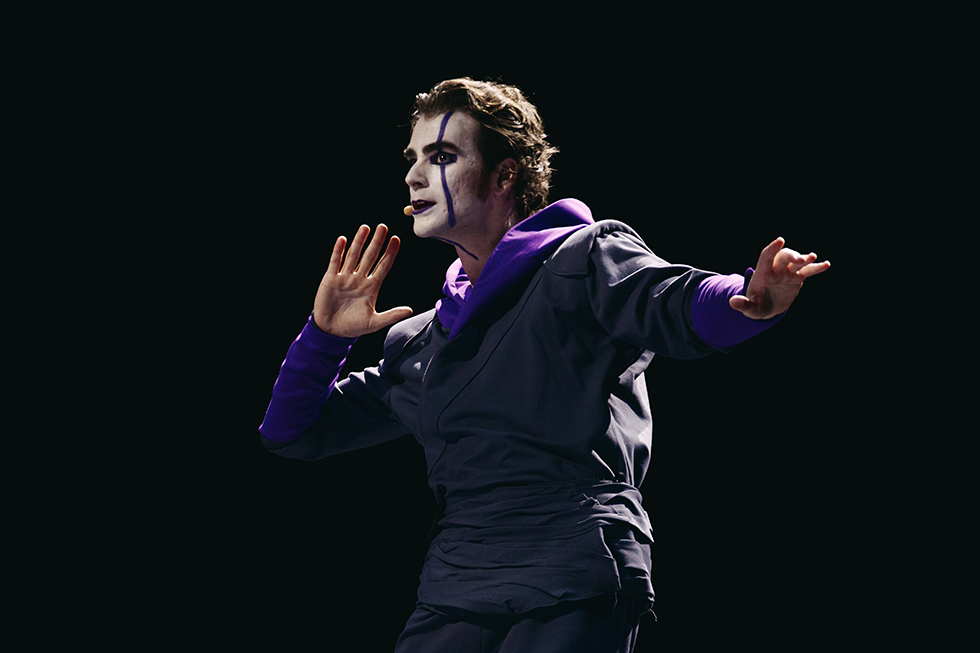
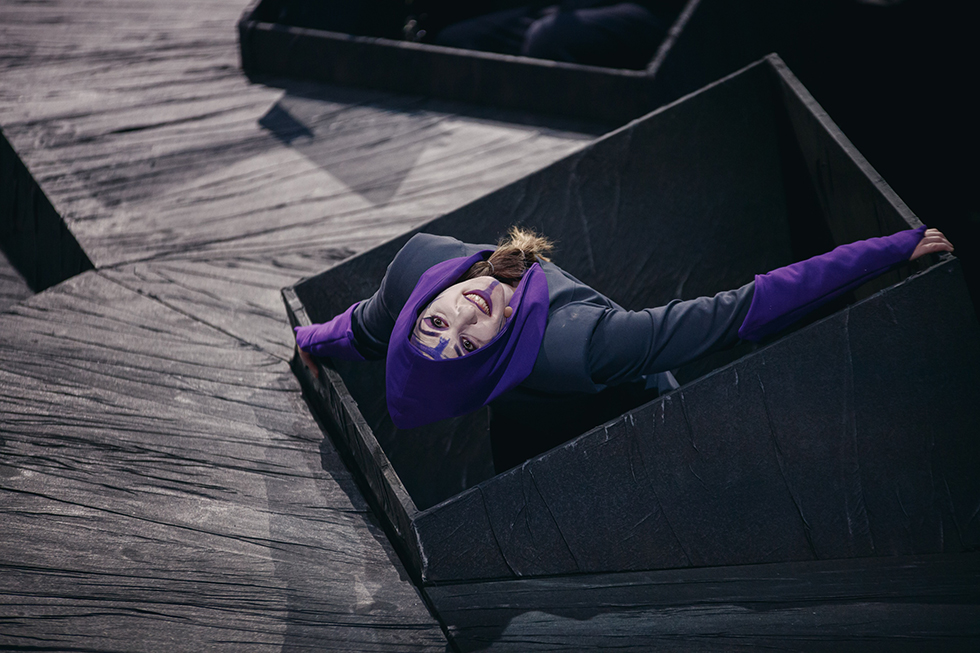
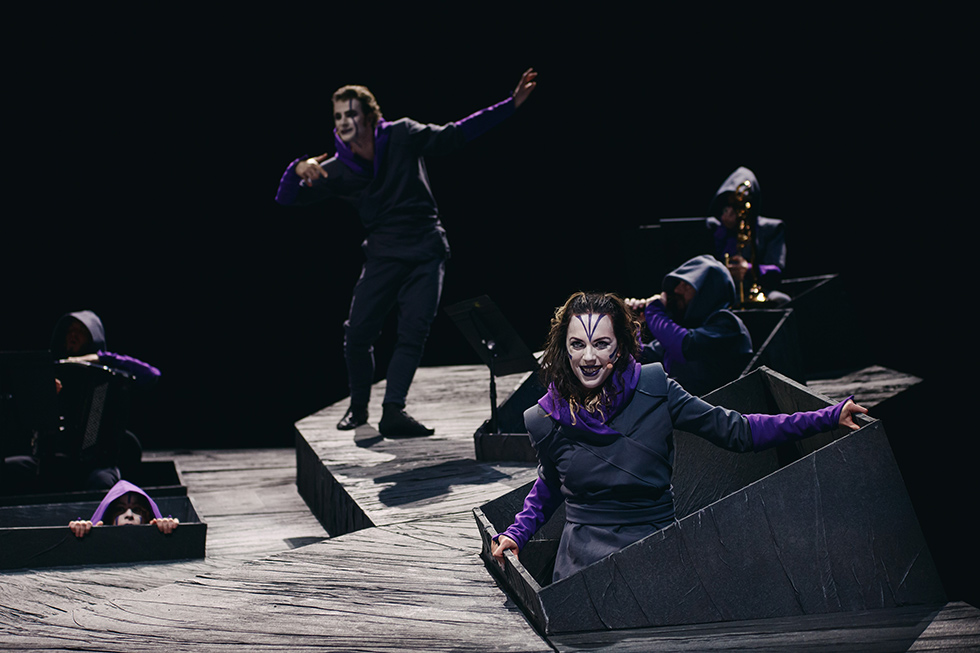
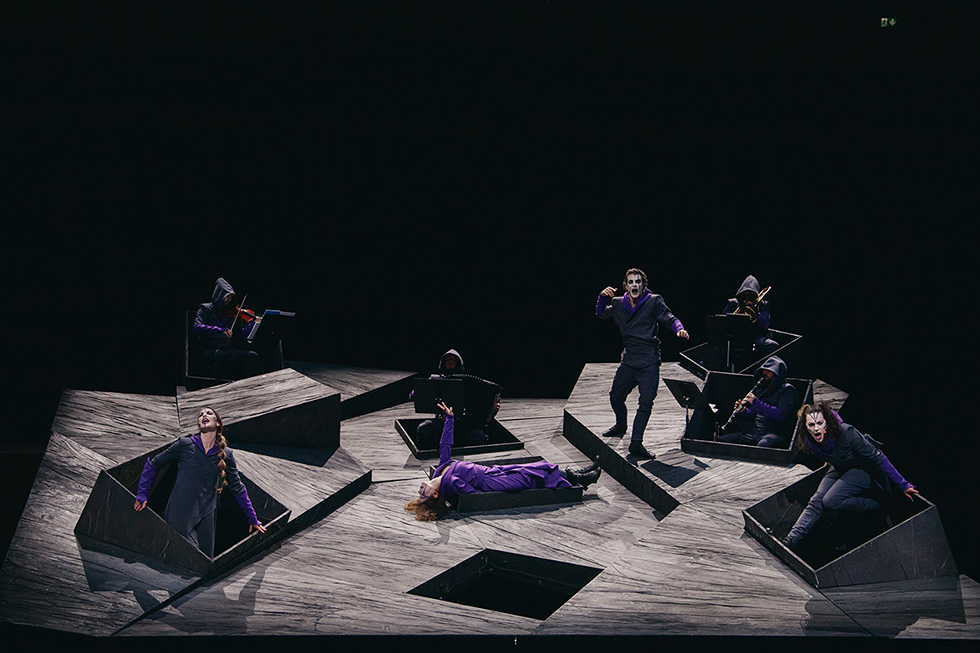
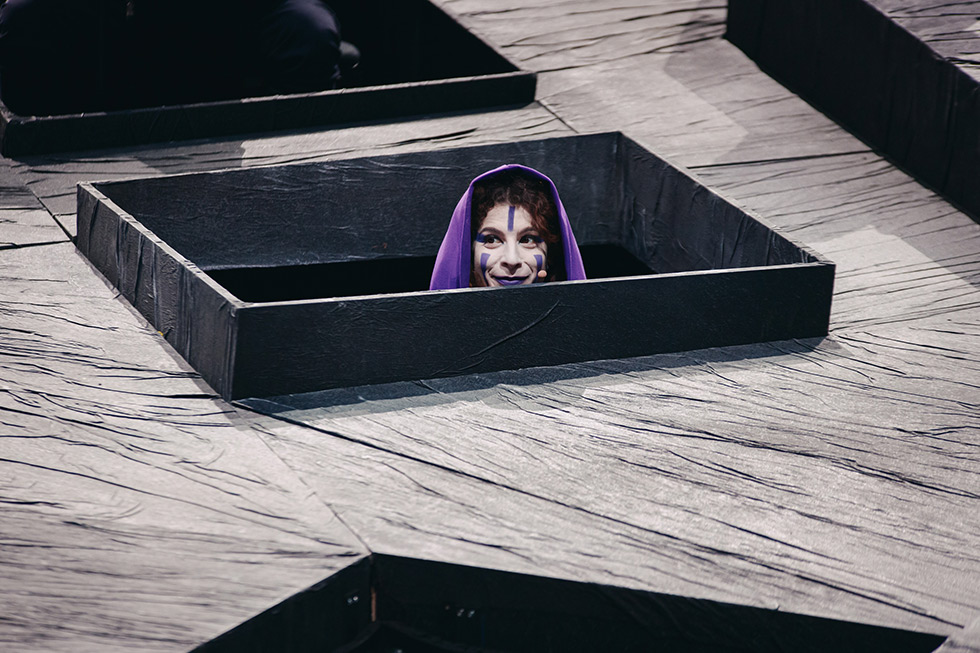
Katerina Papageorgiou's set, who also designed the costumes, alludes to a playful motif of the “Whac-A-Mole” game and war shelters. The actors’ bodies convey a constant feeling of appearing and disappearing, alertness, threat, and suppression. The sense of gloom in a confined space or shelter contrasts with the music's playful and at times sarcastic style.
The lighting design was created by Kostas Bethanis, and Maria Sikitano served as dramaturgy consultant.
Cast: Evelyn Assouad, Elpiniki Marapidi, Rosy Monaki, Stavros Papadopoulos
Featuring musicians from the Ergon Ensemble: Kostas Tzekos (clarinet), Andreas-Roland Theodorou (trombone), Vasilis Soukas (violin), Pericles Sioundas (accordion, vocalist)
Brief biographical notes
Rosy Monaki
Born in Thessaloniki, she is a graduate of the School of Architecture at the University of Thessaly and of the Higher Drama School ‘Andreas Voutsinas’ (2017). She has completed the one-year postgraduate programme in contemporary dance and performance ReDANCE, with Konstantinos Gerardos (2017–2018). She has also attended workshops with Theodoros Terzopoulos, Thomas Velissaris, Simos Kakalas and the Song of the Goat Theatre. With the Zero Point Theatre Company, she has participated in the productions Antigone by Sophocles (2019), Report to an Academy by Franz Kafka (2021), The Persians by Aeschylus (2022), and The Seagull by Anton Chekhov (2023). With the Attis Theatre, she took part in Oresteia by Aeschylus, directed by Theodoros Terzopoulos (National Theatre of Greece, 2024–2025).
Stavros Papadopoulos
Born in Athens in 1996, he studied at the Salzburg Experimental Academy of Dance (SEAD), the Drama School of Municipal and Regional Theatre of Patras, and the Law School of the National and Kapodistrian University of Athens. As a performer, he participated in the productions Requiem for the End of Love, choreographed by Dimitris Papaioannou (GNO, 2026), and Oresteia, directed by Theodoros Terzopoulos (National Theatre of Greece, 2024–2025).
Evelyn Assouad
Actress and singer based in Athens. She graduated from the Drama School of the National Theatre of Greece. In 2018, she played Cassandra in Euripides’ The Trojan Women, directed by Theodoros Terzopoulos, which toured Greece, Cyprus, China, and Japan. Since 2015, she has participated in nearly all productions of the Zero Point Theatre Company at the new Attis Theatre venue. From 2019 for the next two years, she portrayed Antigone in Sophocles’ Antigone, directed by Savvas Stroumpos, which in 2022 received the Ancient Drama Award at the Karolos Koun Awards. In 2022 and 2023, she performed as Atossa in Aeschylus’ The Persians during the company’s summer tours in Greece and abroad. In 2022, she also appeared in the award-winning film Behind the Haystacks by Asimina Proedrou. During the summers of 2024 and 2025, she drew wide acclaim for her portrayal of Cassandra in Theodoros Terzopoulos’ Oresteia, touring Greece, China, Italy, Austria, and Hungary. She is the vocalist of the progressive ethnic band PAGAN, known for its highly theatrical performances, combining ethereal vocals with acting and dance. PAGAN’s music has been featured in ANT1’s TV series Psychokores and in the major GO GREEN advertising campaign by Zagori, starring Tasos Nousias. She also sang on the soundtrack of the film Abyss In (2022) by Yannis Aivazis, which won two awards at international festivals. This year, she stars as Aspasia in ALPHA’s major TV production The House by the River, directed by Antonis Angelopoulos. Her mother tongues are Greek and French, and she speaks fluent English and some Arabic.
Elpiniki Marapidi
Born in Corfu in 1995. She graduated from the Higher Drama School of the Municipality of Agia Varvara ‘Iakovos Kambanellis’ (2020). She is also a graduate of the Foundation in Fine Arts of the University of the Arts London (2015) and from DLD College London (Visual Arts, Psychology, English Literature, 2014). She studied piano and music theory at the Philippos Nakas Conservatory and the Ionian Conservatory (2000–2010). She is a permanent member of the Zero Point Theatre Company, with which she participated in Anton Chekhov’s The Seagull, directed by Savvas Stroumpos (2023–2025) as well as in the National Theatre of Greece’s production of Oresteia, directed by Theodoros Terzopoulos (2024–2025).
Katerina Papageorgiou
Studied architecture at the Aristotle University of Thessaloniki and dance. She holds a PhD in Theatre Studies from the School of Drama, Faculty of Fine Arts, AUTh. As an architect, she has studied the architecture and typology of theatrical spaces in Athens, which were formed in pre-existing architectural shells and shaped the Greek theatrical reality of the last 25 years of the 20th century, hosting the most active and experimental theatrical troupes in the country. As a dancer, she was a key member of the dance theatre group vis motrix. Since 2001, she has been designing sets and costumes for theatre, opera, dance, for performance and art installations, and for cinema. She has collaborated with GNO, National Theatre of Northern Greece, Opera of Thessaloniki, Athens Epidaurus Festival and several experimental theatrical groups, many directors and artists, covering a wide range of classic and modern repertory. Her works have been presented abroad and at international festivals. Since 2022, she has collaborated with the Zero Point Theatre Company and the director Savvas Stroumpos. Since 2020, she has taught on the undergraduate programme at the School of Drama of AUTh, at the Scenography and Costume Design major specialisation.
https://katerinapapageorgiou.wordpress.com

STAVROS NIARCHOS FOUNDATION
CULTURAL CENTER
364 Syggrou Avenue, Kallithea
Box Office:
+30 213 0885700
Box Office email:
boxoffice@nationalopera.gr
Daily 09.00-21.00
info@nationalopera.gr