Contact
ADDRESS
STAVROS NIARCHOS FOUNDATION
CULTURAL CENTER
364 Syggrou Avenue, Kallithea
TEL.
Box Office:
+30 213 0885700
Box Office email:
boxoffice@nationalopera.gr
Daily 09.00-21.00
info@nationalopera.gr
Register to our Newsletter




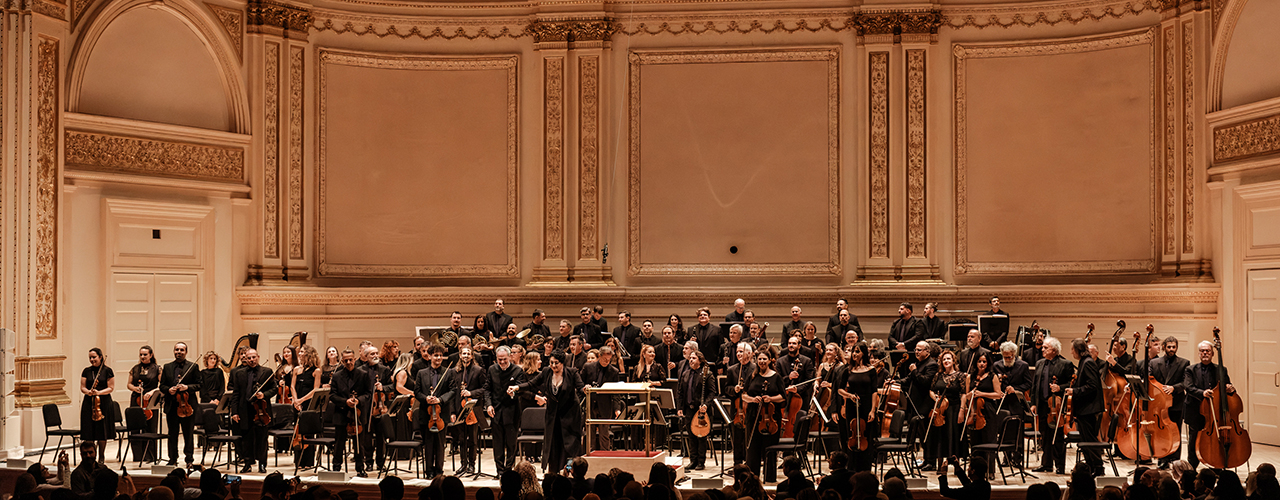
The GNO concert Nikos Kazantzakis: An Odyssey in Music was a tremendous success at a packed Carnegie Hall
With a unique programme of Greek art and folk music inspired by Nikos Kazantzakis’ oeuvre, the Greek National Opera made a highly successful New York debut on Thursday, 15 October 2026. The concert was made possible by a grant from the Stavros Niarchos Foundation (SNF) to enhance the GNO’s artistic outreach, and is part of the celebrations marking the Stavros Niarchos Foundation (SNF)’s 30 years of grantmaking. The enthusiastic, deeply moved audience that flooded the 3,000-seat Stern Auditorium / Perelman Stage at the historic Carnegie Hall gave a standing ovation to the Greek National Opera Orchestra, conductor Vassilis Christopoulos, the Manos Hadjidakis Ensemble, and soloists Anita Rachvelishvili and Maria Kostraki.
The programme of Nikos Kazantzakis: An Odyssey in Music built a unique musical bridge linking different generations of Greek composers. Despite their diverse aesthetics and artistic paths, all five composers were deeply inspired by Nikos Kazantzakis’ spiritual universe and the island of Crete—whether as a place of origin, a source of heritage, or a symbolic reference.
The event was held with the support of the Minister of Culture, Lina Mendoni, and financial assistance from the Hellenic Ministry of Culture.
The concert was part of the celebrations marking the Stavros Niarchos Foundation (SNF)’s 30 years of grantmaking, held in the presence of the SNF Board Co-President, Andreas C. Dracopoulos, and executives.
The Official Corporate Partners of the Greek National Opera’s Carnegie Hall Debut are Capital Clean Energy Carriers and Evangelos Marinakis, who champions Nikos Kazantzakis’ work as the Grand Sponsor of the Kazantzakis Museum in Heraklion, Crete. Mr Evangelos Marinakis and the executives of Capital Clean Energy Carriers graced the GNO concert with their presence.
The concert began with the GNO Orchestra performing Dimitri Mitropoulos’ (1896–1960) remarkable youthful work, Cretan Feast, arranged for grand orchestra by Nikos Skalkottas. Enchanted by Cretan culture, the prominent Greek 20th-century conductor and, among other things, Director of the New York Philharmonic, composed this piece, inspired by the mantinada ‘I will no longer cook broad beans, I will no longer put a pot on the fire’, which he first heard in 1917 while serving in the Band of the Athens Military Guard, from his fellow soldiers. Mitropoulos, a personal friend of Nikos Kazantzakis, dedicated the Cretan Feast to the then Greek Prime Minister, Eleftherios Venizelos, and drew melodic inspiration from the rich style of the late Romantic era as well as from intense sound nuances, which reveal his willingness to break free from the rules of a National School and to discover other expressive means.
Next, the Three Cretan Dances by Nikos Skalkottas (1904–1949)—a prominent composer of modern Greek music—brought the energy, pulse, and valour of Cretan traditional dances to Carnegie Hall. He preserved the folk authenticity of dances such as pidichtós, syrtós, and pentozális, combining it with his personal, polyphonic, and often avant-garde compositional style. In his Greek Dances (1931–1935), Skalkottas sought to bridge folk tradition and art music, highlighting the musical traits and diversity of the Greek landscape while employing modern, groundbreaking arrangement techniques.
The first part of the concert concluded with a resounding round of applause for Giorgos Koumendakis’ symphonic work Amor Fati, presented for the first time in the USA in a distinctive reading by Vassilis Christopoulos. Composed in 2007 to commemorate the fiftieth anniversary of the author’s death, the work captures Kazantzakis’ concept of accepting one’s fate and the composer’s deep connection to Cretan musical identity. A major milestone in the compositional path of GNO Artistic Director Giorgos Koumendakis—one of the most gifted and versatile Greek composers of our time—, the work experientially embodies the Cretan musical tradition through abstract orchestral writing, without traditional instruments. The composer poetically conveys Kazantzakis’ words through the transcription of real bird-chirping patterns. The balance between the sounds of Dionysian winds and those of Apollonian string instruments evokes the ‘tragic’ coexistence of body and spirit, logos and passion, the love of one’s destiny and man’s dual nature.
The second part of the concert opened with Manos Hadjidakis’ (1925–1994) unique piece, Captain Michalis, evoking a deep emotional response from the audience. The Manos Hadjidakis Ensemble delivered a performance of exceptional sensitivity, with Maria Kostraki as the soloist, under the musical direction of Vassilis Christopoulos. For this cycle, Hadjidakis drew inspiration from Nikos Kazantzakis’ novel of the same name, using lyrics based on the author’s direct quotations. The work focuses on the coexistence of Greeks and Turks in 19th-century, Ottoman-ruled Crete. It uses traditional instruments to represent two parallel worlds, mirroring the lives of the main heroes, Christians and Muslims. In this widely popular work, Kazantzakis’ themes of freedom, sacrifice, and inner conflict are transformed by Hadjidakis’ music, not as epic narration but as lyrical, existential commentary. The piece is closer to Western music, despite the fact that many of its melodic lines are rooted in rebetiko modes.
The GNO concert in New York concluded with Mikis Theodorakis’ Dionysian Zorbas, in an atmosphere of celebration and exhilaration. The most famous Greek music worldwide, ‘Zorba’s Dance’, in its symphonic version, fascinated and moved not only the Greek-diaspora audience but also the Americans who flocked to the concert. Theodorakis’ music for Michalis Cacoyannis’ film Zorba the Greek (1964), based on Kazantzakis’ novel Zorba the Greek (Life and Times of Alexis Zorbas), became a symbol of freedom, inspiring generations of audiences worldwide. With this work, Theodorakis gave Zorba a distinct musical identity and voice that have come to be associated with the Greek spirit worldwide. Internationally acclaimed mezzo-soprano Anita Rachvelishvili performed the work’s three famous songs (‘Me t’asteraki tis avgis’, ‘Marina’, ‘Strose to stroma sou’) for the first time, while the GNO Orchestra, under the baton of Vassilis Christopoulos, delivered a performance entirely in keeping with Theodorakis’ spirit, earning resounding applause and praise.
Nikos Kazantzakis was born in Heraklion, Crete, when it was still under Ottoman rule. He studied law in Athens and pursued postgraduate studies in Paris. He travelled extensively abroad, often as a newspaper correspondent. He received the International Peace Award and was nominated nine times for the Nobel Prize in Literature. He regarded himself primarily as a poet, having written Odyssey (1938), a grand work comprising 24 rhapsodies and 33,333 verses. However, he became best known for his novels. His works have been translated and published in more than 50 countries and adapted for theatre, cinema, radio, and television. He is the most-translated Greek author worldwide and has been one of the most enduring and fertile sources of inspiration for Greek musical creation throughout the 20th and 21st centuries.
Information about the works featured in the concert and about the author is drawn from a text by Ethnomusicologist Dr Maria Hnaraki, published in the programme for the GNO concert at Carnegie Hall.
The GNO’s concert in New York took place under the auspices of the Consulate General of Greece in New York and the Greek Orthodox Archdiocese of America. The event was honoured by the presence of Ms Iphigenia Kanara, Consul General, and His Grace Bishop Nektarios of Diokleia, representing the Greek Orthodox Archdiocese of America.
STAVROS NIARCHOS FOUNDATION
CULTURAL CENTER
364 Syggrou Avenue, Kallithea
Box Office:
+30 213 0885700
Box Office email:
boxoffice@nationalopera.gr
Daily 09.00-21.00
info@nationalopera.gr