
Contact
ADDRESS
STAVROS NIARCHOS FOUNDATION
CULTURAL CENTER
364 Syggrou Avenue, Kallithea
TEL.
Box Office:
+30 213 0885700
Box Office email:
boxoffice@nationalopera.gr
Daily 09.00-21.00
info@nationalopera.gr
Register to our Newsletter






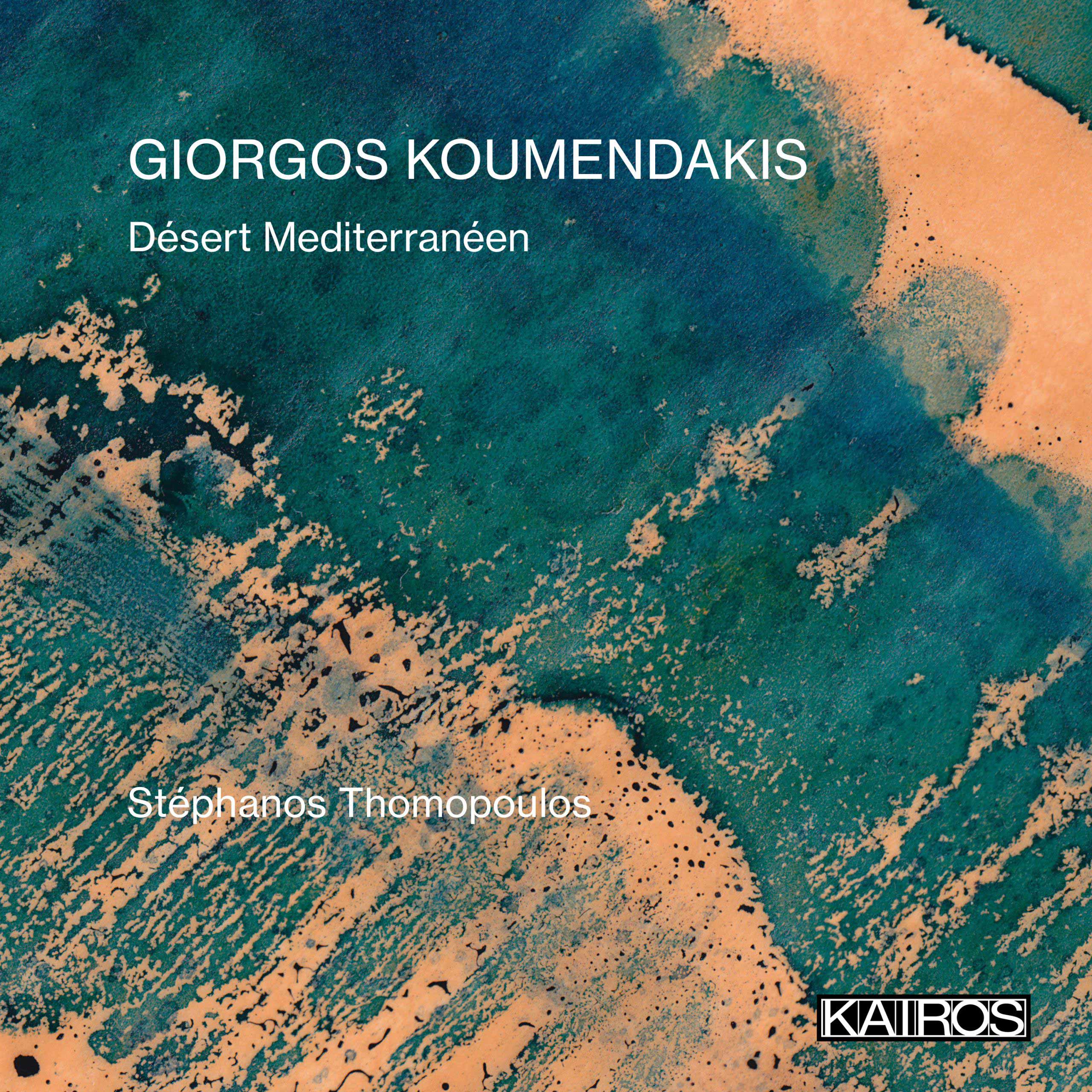
Mediterranean Desert by KAIROS recordings
&
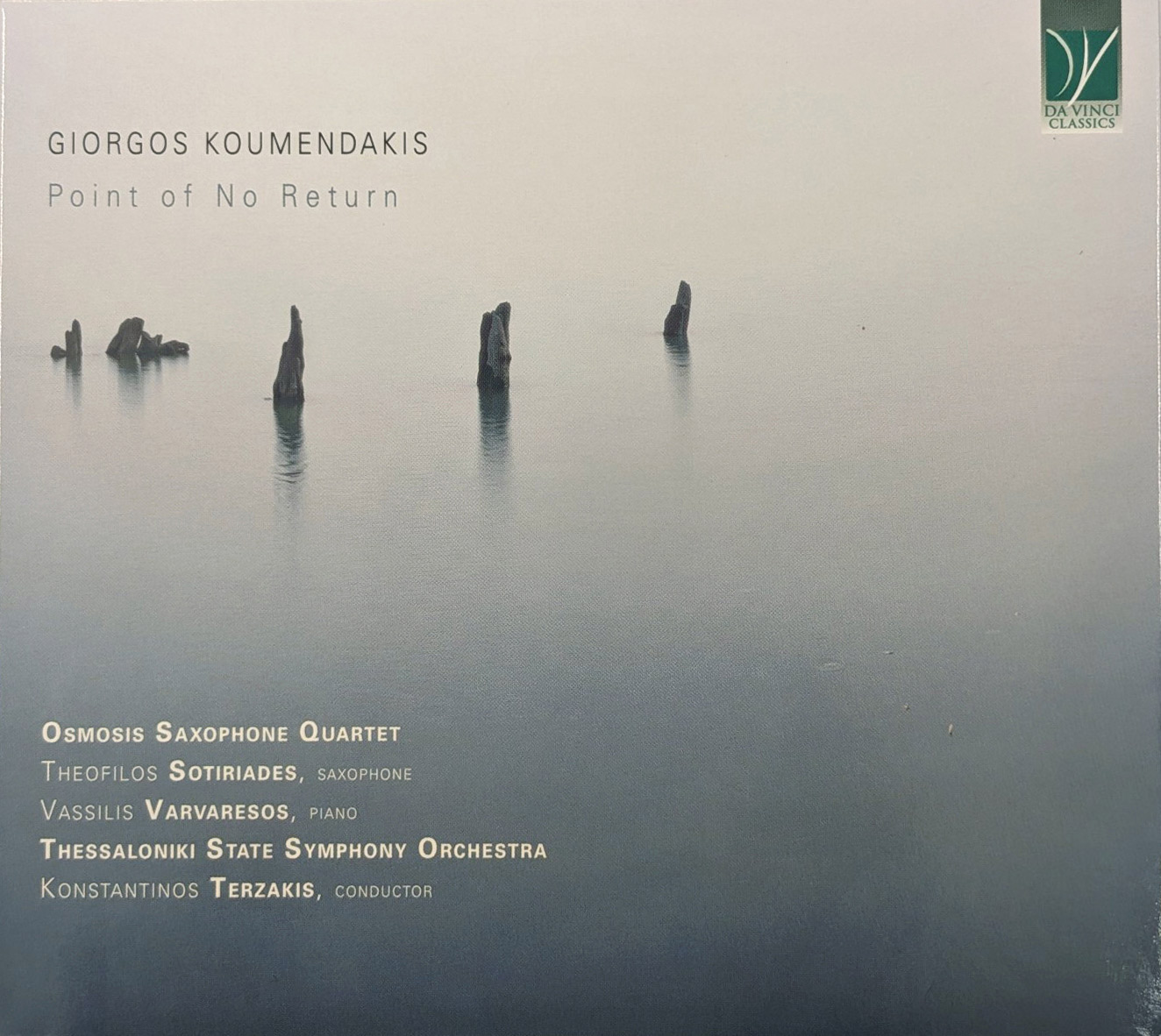
Point of No Return by Da Vinci Classics
Two new CDs featuring compositions by Giorgos Koumendakis are now available across the globe. The piano work Mediterranean Desert, performed by internationally acclaimed pianist Stéphanos Thomopoulos, has been released by the leading Austrian record label KAIROS, one of the most important in contemporary music. Point of No Return, featuring four compositions by Giorgos Koumendakis, has been released worldwide by Da Vinci Classics, one of the most acclaimed independent classical music record labels, with contributions from the Thessaloniki State Symphony Orchestra, the Osmosis Saxophone Quartet, saxophonist Theofilos Sotiriades, and pianist Vassilis Varvaresos. The Pedal Tone of a Middle-Aged Man is conducted by Konstantinos Terzakis.
The Mediterranean Desert cycle brings Giorgos Koumendakis’ pianistic writing into the spotlight. It represents a rare blend of delicacy, intellectual concentration, and profound compositional coherence. This work consists of 22 pieces, each inspired by the Mediterranean flora and fauna, offering a unique sonic map of the Mediterranean landscape. The starting point for this composition was the relationship between modern humans and their natural environment.
In Point of No Return, Giorgos Koumendakis’ musical language stands out for its blend of Byzantine tradition, Greek folk music, and modern composition. Using the saxophone as a connective thread linking all four pieces, the album spans a range of musical forms and reveals the expressive and transformative power of this instrument within a sound world where memory, tradition, and contemporary creation engage in a constant conversation. The continuous transformations of the musical material, free repetitions, and micro-variations form an idiom in which memory serves as a creative process, rather than as a reproduction. Tradition does not manifest in its pure form but rather as a trace and a reminiscence that permeates every musical moment.
MEDITERRANEAN DESERT
The album Mediterranean Desert is a journey through Giorgos Koumendakis’ piano compositions. Inspired by the Mediterranean landscape’s natural wealth and memories, this work transforms the region’s lived experience into a poetic sonography. Mediterranean plants, insects, fish, and birds emerge as protagonists—carriers of emotions and symbolism—in the musical narrative, transcending their descriptive and naturalistic dimensions and taking on an almost archetypal form. Through this process, images and senses deeply inscribed in the collective unconscious transform into a poetic meditation on humans’ relationship with their natural environment. Standing out among this album’s compositions are representative pieces from different creative periods of the composer, offering a comprehensive overview of the evolution of his piano style. From the multilayered, dense writing of Symmolpa to the simplicity and purity of The Silk Road, and from the distinctive encounter between speech and music in Mantinada for Piano to The Cormorant of Iannis Xenakis, a world emerges in which contemporary musical writing constantly converses with memory, orality, and the multiple textures and layers of Mediterranean culture.
Giorgos Koumendakis’ musical language is notable for seamlessly assimilating diverse musical and aesthetic influences into an absolutely distinctive compositional idiom. In his writing, Baroque polyphonic textures and the richness of Renaissance sounds meet the minimalist economy and impressionistic treatment of timbre and harmonic shades. Deeply connected to its Mediterranean roots, Koumendakis’ music is also naturally integrated into the broader European piano repertoire.
Stéphanos Thomopoulos has played a decisive role in bringing to light the piano landscape of the Mediterranean Desert. The internationally renowned Greco-French pianist is known for his creative approach, which bridges the classical repertoire and contemporary composition. He has performed at prestigious halls and festivals around the world, collaborated with celebrated composers and contemporary music ensembles, and has a discography that includes recordings that have gained international acclaim. In addition to his concert and research work, he is a professor and coordinator of the piano department at the Regional Conservatoire in Nice, France, and plays a prominent role in music education. Regarding the album Mediterranean Desert, he characteristically remarks: ‘This album is […] dedicated to the unique voice of Giorgos Koumendakis—his personal way of shaping the pianistic material with wisdom, insight, and emotion. It is a microcosm of Mediterranean sounds, forms, and souls, conveyed with internal precision and devotion.’
Since its founding in 1999, the KAIROS record label, which released the album Mediterranean Desert, has established itself internationally as one of the most important contemporary music labels. Its catalogue includes collaborations with renowned composers and artists of the 20th and 21st centuries, such as Kaija Saariaho, Salvatore Sciarrino, Morton Feldman, Luigi Nono, and Olga Neuwirth, as well as with some of the world’s most prominent orchestras, including the Berliner Philharmoniker, London Symphony Orchestra, Wiener Philharmoniker, and Wiener Symphoniker.
POINT OF NO RETURN
The album Point of No Return features four pieces by Giorgos Koumendakis that revolve around Greek musical tradition, which the composer reimagines through his distinctive contemporary musical language. At times he draws on traditional themes in their original form, and at other times he reconstructs their memories and traces, transforming tradition into an experiential and poetic form. The saxophone serves as the album’s connective thread, running through four pieces of varying scales—from the string orchestra to the saxophone quartet and the solo saxophone—highlighting the instrument’s unique expressiveness through a creative collaboration between the composer and saxophonist Theofilos Sotiriades. The album’s four pieces illuminate different aspects of Koumendakis’ creative relationship with tradition. The Pedal Tone of a Middle-Aged Man, Concerto No. 4 for piano, saxophone quartet, and string orchestra, is part of a series of compositions by Koumendakis that focus on the creative use of the Byzantine isokratima. In this piece, isokratima, beyond its tonal basis, retains its ritual essence, through which the composer weaves a personal, autobiographical narrative about the transition from youth to middle age. In the Typewriter Tune for saxophone quartet, the composer reshapes and ‘transforms’ the Cappadocian dance Koniali, which is part of the Typewriter Tunes cycle, a set of works that attempt to decode, in musical terms, letters to different recipients. In this piece, the recipient is John Cassavetes’ film Faces, which sparks a conversation between the musical composition and the emotional world of the film’s heroes. In Forget Me Not for solo alto saxophone—which is also part of the Typewriter Tunes cycle—Koumendakis explores the memory and fragility of human relationships through the piece’s conversation with the flower ‘Forget me not’, drawing on elements of tsamiko dance. Finally, the Point of No Return, transcribed for saxophone quartet by Antonis Fotiadis and based on two emblematic Smyrnaean songs, creates a poetic dialogue between East and West, highlighting the enduring power of musical tradition as a space for encounter and reconciliation.
In Point of No Return, the pieces are performed by the Thessaloniki State Symphony Orchestra, the Osmosis Saxophone Quartet, saxophonist Theofilos Sotiriades, and pianist Vassilis Varvaresos, under the musical direction of Konstantinos Terzakis, one of the most promising emerging Greek conductors with a strong presence across the symphonic, operatic, and contemporary repertoires. The Thessaloniki State Symphony Orchestra (artistic director: Simos Papanas) is the most important symphonic ensemble in Northern Greece and maintains a significant discography with leading labels such as EMI, BIS, NAXOS, and Deutsche Grammophon. The Osmosis Saxophone Quartet was founded in 2022 by saxophonists and educators Christos Zenios (soprano saxophone), Antonis Fotiadis (alto saxophone), Theofilos Sotiriades (tenor saxophone), and Yiannis Myralis (baritone saxophone)—distinguished musicians from Greece and Cyprus who aim to bring out the saxophone quartet repertoire and promote the creation of contemporary works. Theofilos Sotiriades, a core member of the quartet, is a saxophonist, a PhD holder, and an Assistant Professor of Saxophone at the University of Macedonia’s Department of Music Science and Art. He has performed as a soloist at international festivals and concert halls in Europe and the USA, and has also collaborated with renowned musical ensembles and orchestras. The Pedal Tone of a Middle-Aged Man, Concerto No. 4 for piano, saxophone quartet, and string orchestra, is performed by the internationally acclaimed pianist Vassilis Varvaresos, a graduate of the Juilliard School of New York, who has appeared at prestigious concert halls around the world and has collaborated with major orchestras and distinguished maestros.
Da Vinci Classics, which has released Point of No Return, is an independent record label and publishing house founded in 2015 in Osaka, Japan. Over recent years, it has established itself as one of the most active and internationally acclaimed independent labels in the field of art music. Boasting an extensive catalogue that ranges from Renaissance and Baroque music to contemporary works, Da Vinci Classics is renowned for the high artistic quality of its productions, its focus on bringing rare and unexplored repertoire to light, and its close collaboration with accomplished soloists, chamber music ensembles, orchestras, and composers from around the world.
GIORGOS KOUMENDAKIS
Giorgos Koumendakis is one of the most notable contemporary Greek composers, with an extensive body of works ranging from symphonic and chamber music to opera, theatre, dance, and visual installations.
His international career began in 1985 when György Ligeti chose him to compose Symmolpa V, which was presented by the European Union Youth Orchestra under the musical direction of James Judd. In the same year, his work Symmolpa IV was performed at the Venice Biennale by the Divertimento Ensemble under the baton of Sandro Gorli as part of the European Year of Music – Bach Year. In 1987, he collaborated for the first time with the Ensemble InterContemporain and Arturo Tamayo on his work Symmolpa III. In that same year, Matthias Bamert and ECYO presented Symmolpa III at Frankfurter Feste. In 1988, his Symmolpa IV was presented in Hong Kong by Ingo Metzmacher and the Hong Kong Ensemble as part of the World Music Days Festival. In 1990, in Oslo, Koumendakis’ opera The Day Will Come… was performed by the Oslo Sinfonietta under the musical direction of Christian Eggen. In the same year, the Xenakis Ensemble, conducted by Diego Masson, presented his Concertino for Piano at the Nieuwe Muziek Festival in Middelburg, Netherlands.
Winning the ‘Prix de Rome’ scholarship (1992), he became a resident composer at the French Academy in Rome (Villa Medici). In that same year, the pianist Jay Gottlieb performed Symmolpa I at the Festival Présences ’92, the Tage für Neue Musik in Zurich, and the Lecce Festival. In 1994, he received the ‘Nikos Kazantzakis’ prize. In 1998, his work Journey Into the Night (Voyage dans la nuit) was performed by the Mediterranean Youth Orchestra under the musical direction of Henri Gallois at the Aix-en-Provence Festival. From 1998 to 2000, he served as a composer-in-residence with Clio Gould and the BT Scottish Ensemble in London. In 2000, the Nash Ensemble presented his Concertino for Piano.
In 2007, he composed Amor Fati for the 50th anniversary of Nikos Kazantzakis’ death. In 2007/08, he participated in the Cultural Year of Greece in China with the Beijing Symphony Orchestra under the musical direction of Tan Lihua. In 2008, he composed Point of No Return, commissioned by the Kronos Quartet. In 2008, the Orchestra of Colours, conducted by Miltos Logiadis, presented Amor Fati in Madrid, and in 2009 at the Odeon of Herodes Atticus. In that same year, his work Five More Steps Until You Fall Asleep was performed by the dissonArt Ensemble and the Sentieri Selvaggi Ensemble at the Milano incontra La Grecia Festival. In 2010, the Nederlands Blazers Ensemble presented his Typewriter Tune for chamber ensemble in Amsterdam. In 2011, the Prism Quartet presented his Typewriter Tune for saxophone quartet in New York.
In October 2013, his opera Omiros-Orimos was presented in Munich (Gasteig) in a production by
opus21musikplus featuring the Children’s Chorus of the Bavarian State Opera.
He has worked with esteemed creators in the performing arts. His collaboration with Dimitris Papaioannou and Edafos Dance Theatre culminated in the Opening and Closing Ceremonies of the 2004 Athens Olympic Games.
Koumendakis’ discographic presence in Greece and abroad is diverse, including releases such as 4 Works for Aris Christofellis; two works for Edafos Dance Theatre titled Requiem for the End of Love and Iphigenia on the Bridge of Arta; The Brothers Grimm Fairy Tales featuring Olia Lazaridou and the New Hellenic Quartet; and works included in recordings dedicated to contemporary Greek music, such as the Greek Flute Music of the 20th and 21st Centuries featuring Katrin Zenz.
His works have been performed at prestigious venues around the world, including the Salle Olivier Messiaen (Grenoble), the Théâtre de l’Archevêché (Aix-en-Provence), Teatro La Fenice (Venice), Alte Oper (Frankfurt), Benesse House Museum (Naoshima), Concertgebouw (Amsterdam), Purcell Room (London), Wigmore Hall (London), Carnegie Hall (New York), Forbidden City Concert Hall (Beijing), Piccolo Teatro (Milan), and Muziekgebouw (Amsterdam).
Beginning in 2005, he devoted a decade to composing two grand cycles of works, creatively drawing on elements of the Greek folk tradition. The fruits of his efforts were the Typewriter Tunes and the Pedal Tone series, both of which are performed worldwide. This ten-year research into traditional music concluded with the composition of the opera The Murderess in 2014 (commissioned by the Greek National Opera).
From 2017 to the present, he has been the longest-serving artistic director in the 86-year history of the Greek National Opera, decisively contributing to the expansion of its repertoire, its opening to society, and the enhancement of its international presence.
The inclusion of Giorgos Koumendakis’ work in this unique artistic environment of the prestigious labels KAIROS and Da Vinci Classics is not only a recognition of his music’s distinctiveness but also a confirmation of its place in the international landscape of contemporary creation.
Two new international albums from Giorgos Koumendakis
Mediterranean Desert
Giorgos KoumendakisPiano: Stéphanos Thomopoulos
Record label: KAIROS
Distribution:
– Greece: Musical Offering (57 Akadimias St)
– Europe: NAXOS and its international network of collaborators
– United States: MVD (from 7 August 2026)
Online purchase: https://kairos-music.com/products/recording/0022069kai
& https://www.musicaloffering.gr/shop/classical-music/9120010286698-giorgos-koumendakis-desert-mediterraneen-Stéphanos-thomopoulos/
Point of No Return
Giorgos Koumendakis
Featuring: the Thessaloniki State Symphony Orchestra, the Osmosis Saxophone Quartet, saxophonist Theofilos Sotiriades, and pianist Vassilis Varvaresos, with musical direction by Konstantinos Terzakis
Record label: Da Vinci Classics
Distribution: Egea Music
Online purchase: https://davinci-edition.com/product/c01207/
STAVROS NIARCHOS FOUNDATION
CULTURAL CENTER
364 Syggrou Avenue, Kallithea
Box Office:
+30 213 0885700
Box Office email:
boxoffice@nationalopera.gr
Daily 09.00-21.00
info@nationalopera.gr