






























Contact
ADDRESS
STAVROS NIARCHOS FOUNDATION
CULTURAL CENTER
364 Syggrou Avenue, Kallithea
TEL.
Box Office:
+30 213 0885700
Box Office email:
boxoffice@nationalopera.gr
Daily 09.00-21.00
info@nationalopera.gr
Register to our Newsletter






Historic production of 1961
Stage director: Alexis Minotis
Sets, costumes: Yannis Tsarouchis
Choreography: Maria Hors
Reimagined version of the 1961 historic production
Artistic direction: Giorgos Koumendakis
Conductor: Jacques Lacombe
Stage director: Panaghis Pagoulatos
Sets: Lili Pezanou
Costumes: Tota Pritsa
Choreography: Gianna Filippopoulou, Kelly Zambela
Lighting: Christos Tziogkas
Chorus master: Agathangelos Georgakatos
Medea
Anna Pirozzi
Glauce
Danae Kontora
Neris
Alisa Kolosova
Giasone
Jean-François Borras
Creonte
Tassis Christoyannis
Captain of the Guard
Yannis Stamatakis
First maid
Emily Tsimidaki
Second maid
Irena Athanasiou
With the Orchestra and Chorus of the Greek National Opera
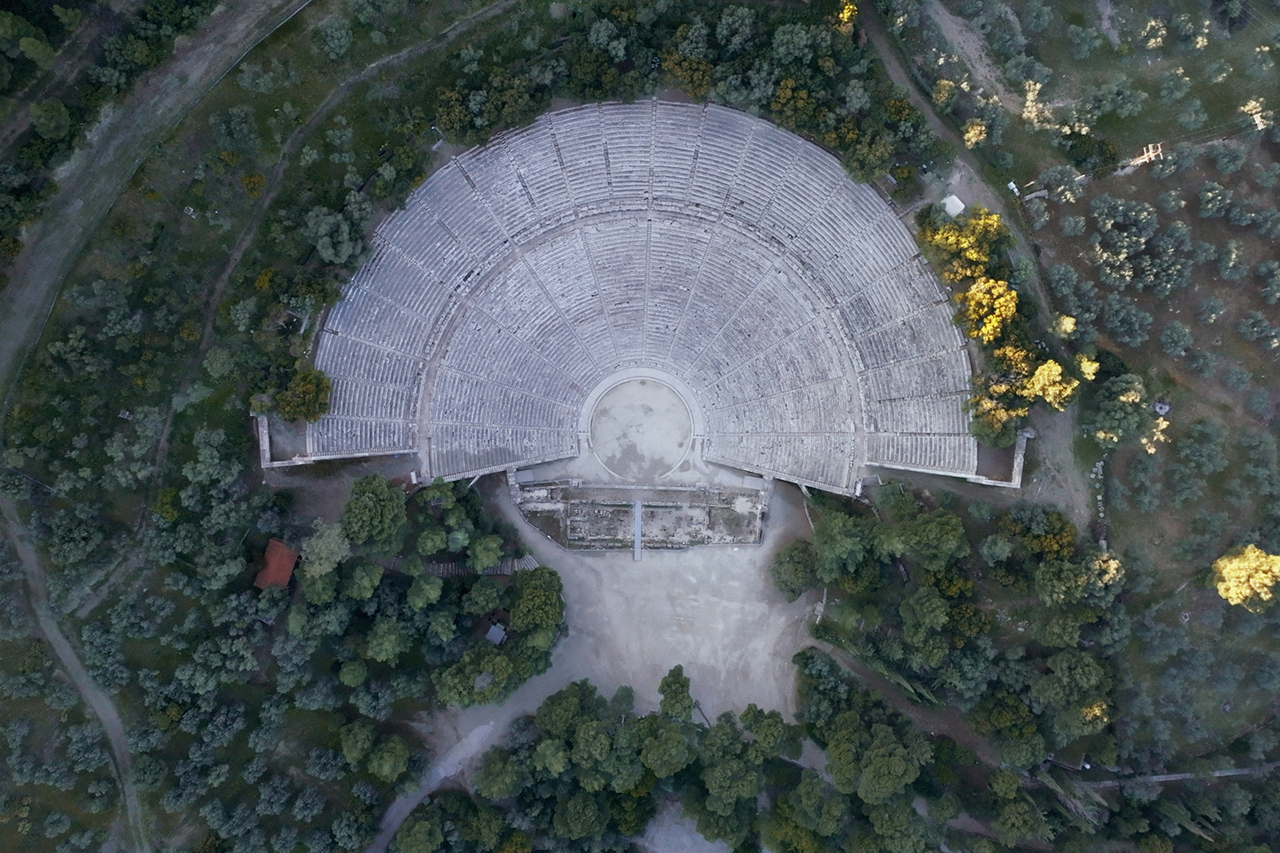
On the occasion of the reimagining of the historic 1961 Medea performance at the Ancient Theatre of Epidaurus, the Greek National Opera presents the exhibition Callas Point in the surroundings of the Ancient Theatre of Epidaurus, from 18 to 21 June 2026, with the support of PPC. The exhibition is curated by the internationally renowned Greek set designer Dionysis Fotopoulos, while the video art and video installation are created by visual artist and video designer Pantelis Makkas. The exhibition will open to the public on Thursday, 18 June, at 08.00 and will remain open to visitors until Sunday, 21 June, at 20.00. Free admission.
More information here.
Audience members who wish to attend the performance of Medea will be offered bus transportation from Athens to the Ancient Theatre of Epidaurus and back at an affordable price (more information here).
Opera • New production • Reimagined version of the 1961 historic production
Starts at: 21.00 | 
Lead Donor of the GNO
Major Sponsor

On Saturday, 20 June 2026, at the Ancient Theatre of Epidaurus, the Greek National Opera will present Luigi Cherubini’s Medea, conducted by Jacques Lacombe and directed by Panaghis Pagoulatos, with Anna Pirozzi in the title role. This production reimagines the historic 1961 Medea, marked by Maria Callas’ unsurpassable performance, with stage direction by Alexis Minotis, sets and costumes by Yannis Tsarouchis, and choreography by Maria Hors. Tickets for the performance opening this year’s Epidaurus Festival have been sold out since last February, just a week after ticket sales opened.
Luigi Cherubini’s opera Medea, based on Euripides’ tragedy of the same name, was brought out of obscurity thanks to Maria Callas, who first performed the title role in 1953 at the Maggio Musicale Fiorentino Festival, reintroducing it to the international stage. Its historic 1961 presentation by the Greek National Opera at the Ancient Theatre of Epidaurus, directed by Alexis Minotis, with sets and costumes by Yannis Tsarouchis and choreography by Maria Hors, was a major highlight in modern Greek cultural history and left an indelible mark on our collective memory.
Cherubini composed Medea in the late 18th century, based on a French libretto by François-Benoît Hoffman. The work premiered in Paris in 1797. The GNO presents the opera’s Italian version, in Carlo Zangarini’s translation and with set dialogues by Franz Paul Lachner, following Callas’ tradition. At the work’s core lies a profound psychological portrait of Medea, who appears as a wounded, passionate, and intensely humane woman, walking a tightrope between despair and humiliation and the vindictive fury that drives her to reclaim her supernatural aspect as a sorceress.
The 1961 Medea—one of the most important artistic highlights in post-war Greece—connected the Greek National Opera with the world’s most prestigious operatic centres. When the newly founded Dallas Opera commissioned Maria Callas for a new production of Medea in 1958, La Divina requested that it be directed by Alexis Minotis, a Greek director associated with ancient Greek tragedy like no other. Despite his initial hesitations, due to his lack of experience in opera, and thanks to the persistence of leading Greek actress Katina Paxinou, Minotis accepted. He also proposed the renowned Greek painter Yannis Tsarouchis as the set and costume designer. The Dallas premiere was met with unprecedented success and rave reviews speaking of a ‘supernatural yet at the same time humane Callas’, ‘a rejuvenating air of Minotis’ staging’ and ‘the 130 unique costumes by Tsarouchis, made in Greece’. After its premiere at the Dallas Opera, the production was showcased at the Royal Opera House in London in 1959. It was then presented at the Ancient Theatre of Epidaurus during the summer of 1961 and concluded its tour at La Scala in Milan in 1962.
For the open-air space of Epidaurus, Minotis recrafted the direction, wanting, as he had said, to ‘recover as much as possible the function of the myth according to the ancient model without, however, neglecting the famous composer’s music not for the least’. At the same time, Tsarouchis adapted the set especially for the ancient theatre and created new costumes for the overall 250 people present on stage. The spotlight was on Maria Callas’ unparalleled performance. She was glorified for the dramatic intensity, theatricality, and unique expressiveness in her vocal delivery, solidifying her legendary status as the 20th century’s preeminent opera singer. That production went down in history as a personal triumph for Callas and as an emblematic artistic achievement that brought Greek creativity to international prominence, leaving an indelible mark on our collective memory.
Sixty-five years later, the Greek National Opera sheds light on this historic production as part of its 2025/26 season’s thematic focus, ‘The opera of the future arises from the womb of the past’, under the artistic direction of Giorgos Koumendakis.
Through Alexis Minotis’ staging manuals, Tsarouchis’ designs, and the surviving photographic material from Callas’ iconic performances in Epidaurus, a reimagining of the original 1961 production has been created, as conceived and presented by those legendary artists who have stamped their mark on Greek culture.
Panaghis Pagoulatos, with extensive experience in opera direction and years of studying Maria Callas’ influence on the art of opera, directs this production. His work is grounded in consistent research into archival materials—photographs, staging notes, scores, costumes, and correspondence from the period. Approaching the work with deep respect for Cherubini’s musical dramaturgy and, at the same time, for the tradition of ancient tragedy and Minotis’ theatre language, he opts for a minimal and strict stage rendition that follows both the letter and the spirit of the historic 1961 production. As the director notes, ‘Alexis Minotis was a theatre director particularly involved with ancient tragedy. From the sets, costumes, photographs, and his notes, we can confirm that his direction was faithful to the libretto. He followed the text and the composer’s directions with a specific logic. He didn’t do anything contrary to the text, nor anything iconoclastic by modern standards. What was revolutionary for that time was Callas herself, who was the first singing tragedian in the full sense of the word. My stage direction is in line with the same spirit. I did not undertake this project to showcase my personal interpretation of Medea, but to serve a specific vision, that of 1961. Naturally, many adjustments have been made to accommodate differences in the set, the artists’ personalities, and contemporary perceptions of performance.’
Distinguished set designer and professor of set design at the Athens School of Fine Arts, Lili Pezanou, studied photographs and models of Yannis Tsarouchis’ set, including those from rehearsals and the 1961 performance, as well as the surviving correspondence, to reconstruct the Hellenistic Antiquity-inspired sets of the original production, adapting them to how performances at the Ancient Theatre of Epidaurus are staged today.
Starting with the original costumes from the 1961 production, which survive in the GNO’s Costume Department, theatre, opera, and cinema costume designer Tota Pritsa conducted extensive research into the textures, shades, elasticity, fluidity, and even the way folds appear in the fabrics of those costumes for the reimagining of the production. Aligned with Tsarouchis’ goal—who considered it crucial that ‘the costumes should approach the body’s natural movement and the sculptural quality of ancient Greek garments’—the experienced costume designer made adaptations where deemed necessary, without, however, altering his main aesthetic direction. As she characteristically remarks in the note about her work on Tsarouchis: ‘In this case, the costumes do not merely depict an era; they hold a memory. And the stage does not represent—it creates. As if the painter himself had spread his colours over the actor’s body, and then let it move.’
Internationally acclaimed choreographers Gianna Filippopoulou and Kelly Zambela revived Maria Hors’ choreography, based on the notes and directions in the staging notebook. Christos Tziogkas is responsible for the lighting, measuring himself against the great challenge of reconstructing the atmosphere of the 1961 production.
The GNO Orchestra will be conducted by the internationally celebrated conductor Jacques Lacombe in his fourth collaboration with the Greek National Opera, following the productions of La bohème, Werther, and Anna Bolena in this year’s season. Lacombe has previously served as conductor of the Bonn Opera and as musical director of the New Jersey Symphony Orchestra and the Symphony Orchestra of Mulhouse. He has collaborated with many prestigious opera houses, including the Royal Opera House in London, the New York Metropolitan Opera, Deutsche Oper Berlin, and the Bavarian State Orchestra. The GNO Chorus has been coached by Agathangelos Georgakatos.
For the 1961 historic production’s reimagining, the Greek National Opera has secured an excellent, world-class cast, alongside prominent opera singers from the Greek operatic scene.
The title role will be performed by the outstanding Italian dramatic soprano Anna Pirozzi, who debuted in this role in the GNO’s 2023 production of Medea, directed by David McVicar, and received rave reviews for her performance. Pirozzi, whom the Greek audience also thunderously applauded for her portrayal of La Gioconda last October at the GNO, has carved out a unique career since her breakthrough debut in Turin in 2012 and her huge success at the Salzburg Festival as Abigaille in Verdi’s Nabucco, conducted by Riccardo Muti. Anna Pirozzi stars at the world’s most prestigious opera houses, including the Royal Opera House in London, the New York Metropolitan Opera, La Scala in Milan, the Opéra national de Paris, the Vienna State Opera, and Teatro Real in Madrid.
Giasone will be portrayed by the distinguished French tenor Jean-François Borras. Borras has performed at some of the world’s leading opera houses, including the New York Metropolitan Opera and the Opéra national de Paris, as well as at other prestigious venues in cities such as Vienna, London, Munich, Florence, and Venice. At the GNO, he performed as the Duke of Mantua in the 2008/09 season and as Werther in the 2013/14 season.
Making his role debut as Creonte will be Tassis Christoyannis, a distinguished GNO protagonist and the Artistic Director of the Olympia City Music Theatre ‘Maria Callas’. Christoyannis has been starring in Greek National Opera productions since 1989 and regularly performs at some of the world’s most important opera houses, including the Opéra Comique, the Opéra national de Paris, the Théâtre des Champs-Élysées in Paris, and the Royal Opera House in London.
Alisa Kolosova, known to Greek audiences for her performances as Suzuki in the 2023 production of Madama Butterfly and as Laura in the 2025 production of La Gioconda, will portray Neris. The distinguished Russian mezzo-soprano performs regularly at some of Europe’s and the United States’ most significant opera houses and festivals, including Paris, Milan, Munich, Berlin, Vienna, Salzburg, Pesaro, and Glyndebourne.
The role of Glauce will be taken on by the coloratura soprano Danae Kontora, who has already carved out a very important international career. She has performed at many venues in Berlin, Paris, Vienna, Hamburg, Frankfurt, Beijing, Taiwan, and London, among others.
Yannis Stamatakis will perform as the Captain of the guard, and the two maids will be portrayed by Emily Tsimidaki and Irena Athanasiou, respectively.
STAVROS NIARCHOS FOUNDATION
CULTURAL CENTER
364 Syggrou Avenue, Kallithea
Box Office:
+30 213 0885700
Box Office email:
boxoffice@nationalopera.gr
Daily 09.00-21.00
info@nationalopera.gr